News
Brazil Fiscal Crisis: Verifying Bulk Export Flows With Satellites
As sovereign debt pressures build across Brazil, commodity traders are using satellite radar to verify whether major bulk export terminals at Santos and Paranaguá face physical throughput bottlenecks.
Macro fiscal strain meets real-world supply chains
Fresh analysis of Brazil's mounting debt crisis highlights rising sovereign spending pressures and structural fiscal deficits. For commodity traders and DIY macro investors, sovereign fiscal distress rarely stays confined to bond yields and currency pairs.
When state budgets strain, public logistics investment, port maintenance, and customs staffing can lag behind physical trade demand. Brazil remains the world's leading exporter of soybeans, sugar, and raw iron ore, making its major maritime gateways critical to global bulk trade balances.
Why official export prints lag ground reality
Official trade figures published by government ministries provide an accurate backward-looking record of export volumes, but they lag physical movements by several weeks. By the time official customs data confirms a freight backlog at key terminals, dry bulk shipping rates have often already re-priced the regional imbalance.
Traders who rely solely on delayed ministry releases or vessel tracking feeds often miss early physical signals. AIS tracking shows vessel coordinates when transponders are active, but it cannot measure yard density, grain elevator staging activity, or berth turnover when weather or operational friction slows terminal loading.
Measuring bulk terminal density from space
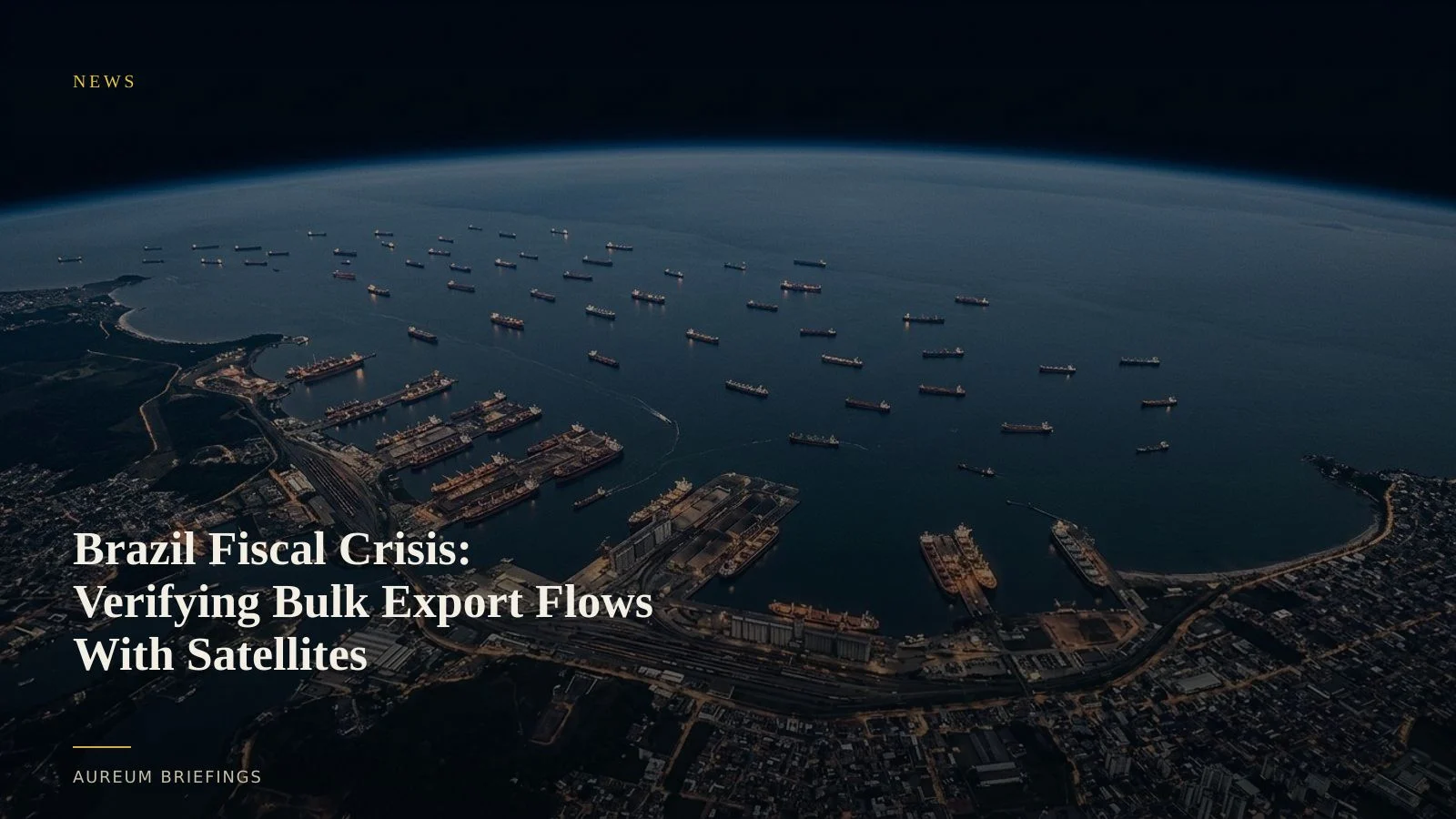
Satellite-backed observation offers a direct, independent way to audit physical export corridors. Using open synthetic aperture radar from Copernicus Sentinel radar coverage, analysts penetrate cloud cover and coastal haze to detect vessel concentrations at offshore anchorages outside Santos and Paranaguá.
By tracking radar signatures across anchorage grounds and observing shadow variations in bulk stockpile yards, satellite analysis establishes whether terminal staging is operating smoothly or building up hazardous backlogs weeks before quarterly earnings or government prints land.
How DIY traders act on physical export signals
When sovereign macro narratives shift, institutional commodity desks rely on proprietary satellite intelligence to confirm if physical supply lines are holding up. Individual investors without a research desk can apply the same verification standard using Aureum.
Instead of guessing whether fiscal policy changes are impairing Brazil's port logistics, you can query specific export corridors directly or follow hand-built boards that track critical bulk transit hubs.
Track physical export signals before official prints
Join the private beta to ask satellite questions or follow hand-built KPI boards on key global transit hubs.