News
China Fuel Export Curbs Loom as Product Stocks Sink: Satellite Verification
Chinese diesel and gasoline inventories have dropped to multi-month lows, raising the prospect of government-enforced export restrictions. Satellite imagery offers early verification of tank levels and export terminal activity.
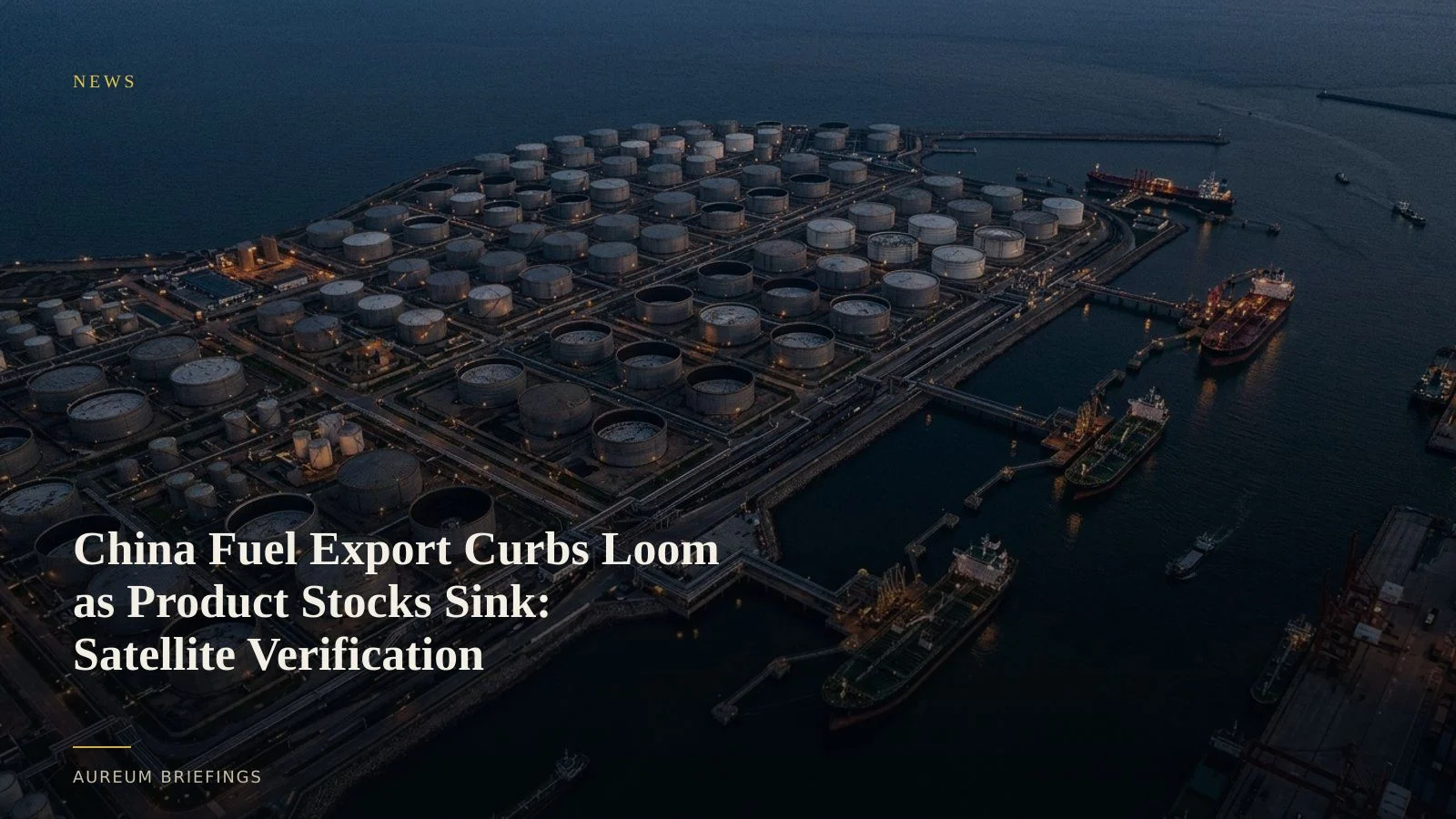
China's refined product stocks plunge to multi-month lows
Reports indicate declining domestic diesel and gasoline inventories at Chinese state-owned majors, with gasoline holdings down 2.9% week-on-week to levels not seen since 2022. Diesel inventories fell 2.4% over the same window, reaching a 15-month low as domestic demand absorbs available refinery output.
If state refiners prioritise local distribution to shore up domestic reserves, export quotas for transportation fuels could be sharply curtailed. Global refined product markets are tightly balanced, meaning any sudden reduction in Chinese outflows directly impacts regional crack spreads across Asia and Europe.
Measuring tank roof shadows and export berth queues from space
Physical verification of refinery inventories relies on measuring floating-roof tank heights and berth activity. Optical imagery captured via open European Space Agency Sentinel imagery allows analysts to track tank roof shadow lengths at key coastal refining hubs such as Ningbo, Zhoushan, and Qingdao.
Shorter internal shadows inside external floating-roof product tanks indicate lower liquid volumes. When combined with synthetic aperture radar passes over marine export terminals, traders can verify whether product tankers are actively loading or departing empty ahead of anticipated export policy changes.
Regional crack spread ripples and global trade shifts
Restricting fuel exports from China tightens diesel and gasoline availability across Asian trading hubs like Singapore. Higher regional product margins alter refinery incentives globally, prompting Middle Eastern and US Gulf Coast refiners to redirect distillate cargoes toward high-premium destinations.
While large institutional trading desks often purchase enterprise crude and product tank analytics platforms to monitor tank farms, DIY traders usually rely on delayed news reports. Aureum bridges this gap by translating satellite imagery into plain-language physical answers without requiring complex GIS software.
Navigating Middle Eastern crude flows and export dynamics
Upstream supply dynamics remain equally sensitive to political and operational shifts. Recent geopolitical adjustments and commercial oil terms in Middle Eastern supply hubs highlight how regulatory conditions and regional stability govern export volumes entering global shipping lanes.
Whether monitoring Middle Eastern crude loading terminals or Asian product storage hubs, physical verification provides an essential foundation for market analysis. By tracking asset-level activity directly from satellite passes, investors cut through market noise before official trade figures publish.
Verify energy markets with satellite intelligence
Private beta is open. Ask Earth a question with Query, or follow hand-built Track boards on major physical energy corridors.