Briefing
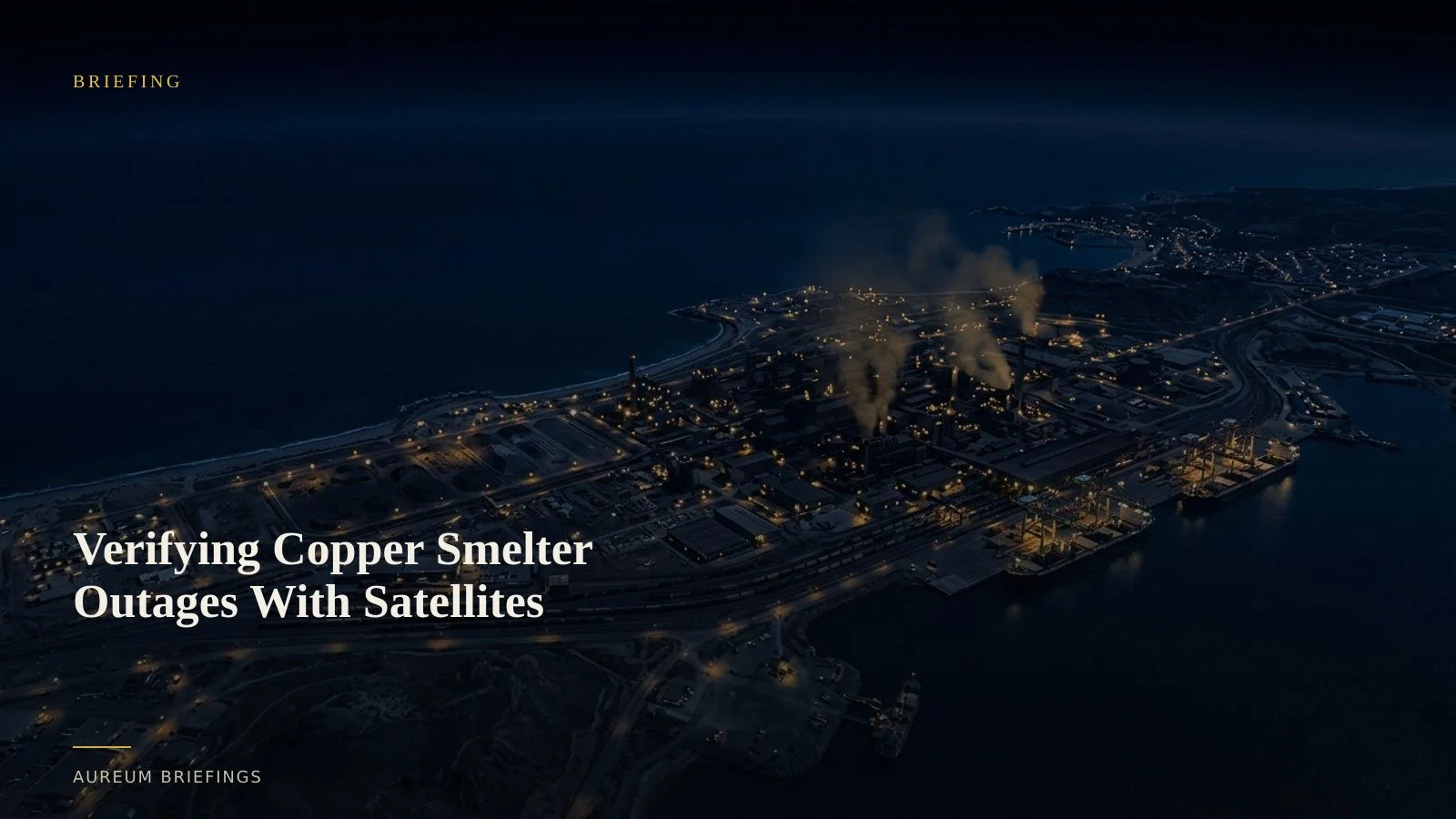
Verifying Copper Smelter Outages With Satellites
Refined copper markets move when key smelters trip, curtail throughput, or enter extended maintenance. Satellite imagery verifies furnace activity and yard inventory before official production prints update.
The gap between operational reality and market prints
Copper concentrate treatment and refining charges fluctuate rapidly when custom smelters alter operational schedules. When an unplanned outage hits a major smelting complex, physical refined metal supply tightens days before exchange warehouse stocks reflect the squeeze.
Official benchmark metrics, such as mineral statistics from the USGS, provide valuable long-baseline context but lag physical operations by weeks or months.
Traders who rely solely on corporate press releases or monthly trade association summaries often miss early operational signals during critical supply disruptions.
What satellite sensors detect at smelting complexes
Primary copper smelting relies on continuous pyrometallurgical processing. Optical and thermal satellite sensors capture distinct physical indicators that reveal whether a facility is operating at full capacity or cooling down.
Shortwave infrared and thermal bands track heat dissipation from flash furnaces, anode furnaces, and acid plant stacks. When a facility enters an unplanned shutdown, thermal intensity drops sharply across multiple passes.
Multispectral optical imagery from Sentinel multispectral satellite observations monitors copper concentrate stockpiles in open storage yards and tracks vessel discharge activity at adjacent port berths.
Distinguishing planned revamps from sudden trips
Not every dip in thermal activity signals an emergency shutdown. Routine maintenance turnarounds are scheduled months in advance and follow predictable baseline patterns.
Satellite-backed verification correlates thermal plume signatures with concentrate intake rates. If raw material piles build up while thermal emissions collapse, the facility is choking on feedstock or suffering an unannounced furnace trip.
Large institutional funds sometimes subscribe to SpaceKnow enterprise analytics platforms to ingest quantitative physical indices. DIY investors and independent commodity traders require the same physical evidence without complex GIS pipelines or enterprise software costs.
Applying satellite evidence to refined metal trades
Verifying physical smelter operational status allows traders to evaluate supply tightness before copper spreads react on futures exchanges.
When an outage is confirmed across successive imagery passes, traders can position around physical tightness, refine arbitrage assumptions, or check downstream cathode availability.
Instead of guessing whether market rumours of a smelter slowdown are accurate, satellite intelligence delivers direct visual and quantitative proof.
Verify physical metal flows before the market
Private beta is open. Follow existing hand-built Track boards or ask Earth direct questions with Query.