Our manifesto
Nobody Gives a Shit About Space
And it’s the Space Industry's Fault
The supply side of the space industry has grown twenty-fold in a decade, but the demand side has barely budged. Despite what analysts will tell you, this isn’t because there’s just no demand for it. We’ve collectively built a system that allows us to see and understand basically every single inch of the Earth, every physical asset in the world, in near-real time, and yet almost nobody outside of the government has a use for that? Nonsense. The industry treats this as an inalienable fact of life, but it’s not; it’s because the industry has been approaching the problem the wrong way. If we actually want to open these capabilities up to the whole world, we should be focusing on meeting potential users where they actually are – driving down costs, simplifying the product, and abstracting away the ‘space’ bit of it as much as humanly possible.
There is precisely one space technology in the last 30 years that has achieved breakthrough to mass consumer scale (~3bn monthly users as of 2026), and yet basically nobody who uses it would describe it as a space product. That’s the point – people don’t care about the ‘space’ bit of space tech, they just want you to solve their problem. In the earth observation industry, however, incumbents have grown so used to selling massive contracts to the tiny number of customers who already care that they’ve never needed to do something about it. This essay is about what that means, why it happened, and how we can change it.
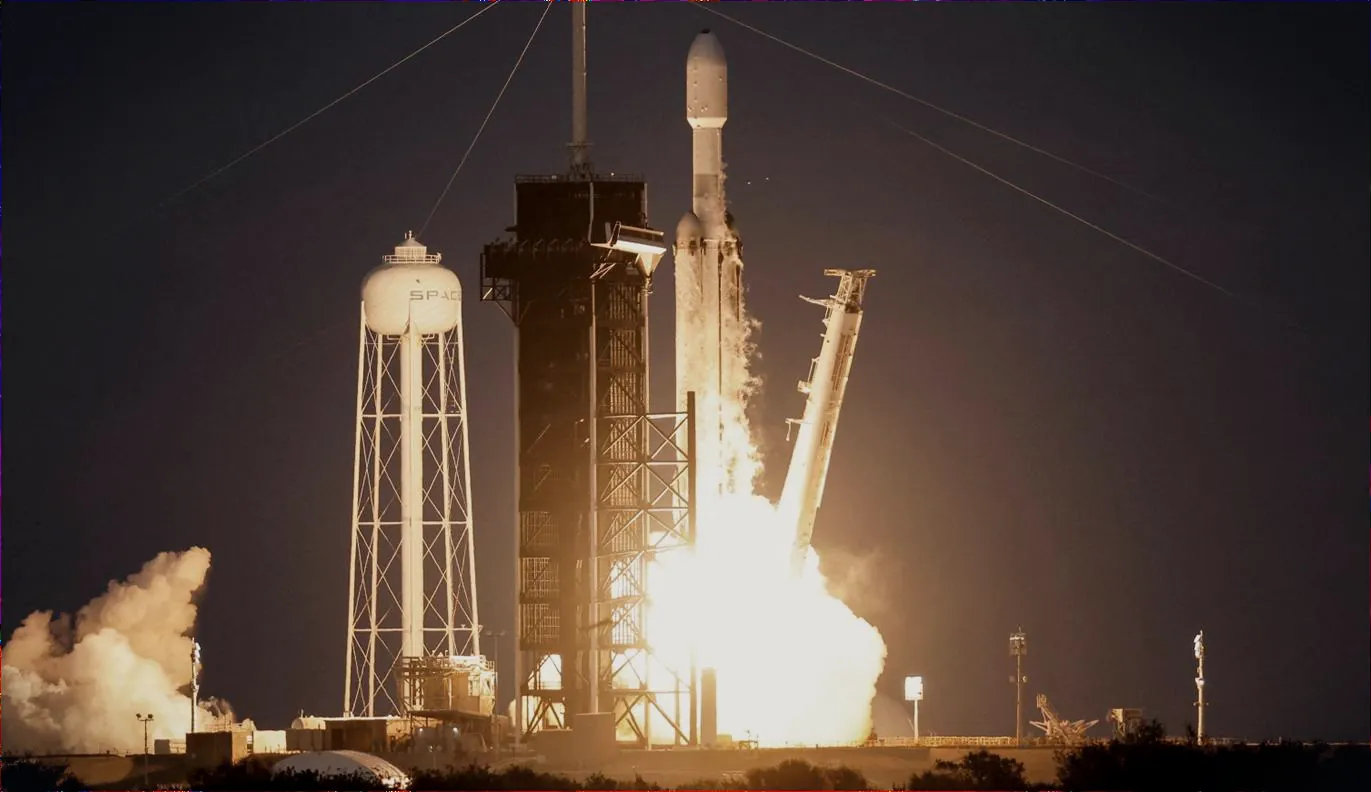
1. Every Space company claims it’s changing the world, but if it’s all so amazing… what’s actually changed?
Read the press releases of any startup in the space industry from the last decade and you’ll start to notice the same phrases over and over: revolutionary, unprecedented, game-changing, democratising.1 Every new satellite constellation is revolutionary, every new data marketplace is a game-changer, every new application/service provider heralds a new era in space tech. Every one promises that this, finally, will be the point when the technology really starts to transform people’s lives. That this is the point when the world will finally sit up and take notice.
And to be fair to the industry, on the supply side at least, it genuinely has been transformed: the number of commercial satellites in space has exploded in the last 20 years. Thousands of imaging satellites now photograph every port, farm, forest, glacier, battlefield and supply chain on Earth, on a daily basis. The number of companies in the space has gone from a handful in the early 2000s to hundreds now. Beyond the satellite operators themselves, a whole ecosystem of data marketplaces, resellers, and analytics providers has blossomed in a way that simply didn’t exist a decade ago. By any measure you want to choose, the supply side of the market has been transformed beyond recognition.
- Active satellites
2026: Active satellites 16,340
And yet, over that same period, the story on the demand side is very different. What in 2000 was a ~$1bn industry dominated almost entirely by government & defence has ‘blossomed’ in 2026 to a ~$5bn industry only mostly dominated by government & defence. A 5x return over 25 years is okay, but if you were an investor, you’d have had a better run just putting your money in an index fund. Hardly world changing. For an industry that is filled with claims of revolutionising the way we live, and that is genuinely filled with a huge number of extremely clever people working on some extraordinarily technologically complex things, it seems to have surprisingly little impact on the lives of most people not directly involved in it.
The honest truth is this: beyond the occasional excitement of seeing SpaceX catch a landing rocket, no one actually cares about the space industry. No one really understands what it does, no one particularly cares about the complexity or the cleverness of the technology, and even when you present people with a massively complex and very impressive piece of technology that might one day change their lives, more often than not they just shrug.
That’s not to say that no-one is getting value from it. They are, it’s just it’s almost entirely government customers or massive commercial enterprises – both of whom are either sophisticated enough to understand (and therefore care) about it, or rich enough to employ an expert who is. What’s worse is that most of this technology was paid for (directly or indirectly) by you the taxpayer. But you get nothing. It’s not just that it’s expensive, it’s almost like the industry actively doesn’t want to sell to you (more on this in chapter 4).
And yet, people clearly do want answers to questions that are answerable from space; since 2022, millions of ordinary people have taught themselves satellite verification by hand, on free low-resolution imagery, sharing homework on Reddit and X. These are not sophisticated institutional buyers; they are ordinary people with laptops, demonstrating every day that the demand is real, but that it currently isn’t being captured by commercial providers. Beyond the people who’ve already discovered the usefulness of satellite imagery (but not yet progressed beyond the free stuff), there are millions more who absolutely should be using it, but currently aren’t. Hundreds of millions of retail investors trade billions of dollars a day, with tens of millions paying for consumer-grade versions of the kind of alternative data products that the professional hedge funds use. Yet for arguably the single most valuable data source imaginable, the ability to actually see what’s happening anywhere in the world in near real time, governments and hedge funds use it, but that seemingly massive group of people with exactly the same latent demand… don’t. Why?
2. There is one space product in the last 30 years that genuinely has changed the world, yet nobody describes it as space tech
And that’s precisely the point. Most people don’t give a shit about space. But they do give quite a lot of a shit about solving their problems. The space products that truly have changed the world did it by solving people’s problems, and in the process making the ‘space’ part of the product completely invisible.
There is only one space product in the last 30 years that has completely cut through the marketing fluff to truly penetrate every facet of everyday life. It's extraordinarily complex: the back end involves massive constellations of satellites, atomic clocks, orbital mechanics, and even relativistic physics. It is, by any engineering standard, one of the most extraordinarily sophisticated systems humanity has ever built. Around 3 billion people use it every month, and most of those use it without ever once thinking about any of that. It’s GPS.2
- GNSS market
- Earth Observation market
2026: GNSS market $375bn, Earth Observation market $5.6bn
But why has GPS been so successful? GPS has existed since the late 1970s; it was first released to the civilian world in limited format in the 1980s. In May 2000, the US government flicked a switch and turned off Selective Availability (the thing that made the highest accuracy positioning available only to the military) and overnight made the product ~10x more accurate for everyone on the planet, entirely for free. And sure, usage crept up slowly, and there was a bump in 2000, but it didn’t really take off until around 2008. Why 2008? What changed?
Two things: smart phones, and Google Maps. Google Maps was first introduced in 2005, and for 3 years it was the computer equivalent of the atlas your parents kept in their car. Then in 2008 that software was combined with the cheap little GPS chip inside the first mass-market smartphones, and suddenly it was everywhere. Why was that the real breakthrough to true mass adoption? Because it came in a brilliantly simple interface that abstracted away all that complicated messy aerospace engineering to deliver a product that solved the user's problem with a little blue dot. Ask a question, get an answer.
If you asked the population about Google Maps, I'm willing to bet that the vast majority wouldn't even think to describe it as a space technology and couldn't begin to explain how it works. But that's the beauty: they don't need to. The fact that the underlying technology and systems architecture that runs Google Maps is extraordinarily impressive and immensely technologically complex is completely irrelevant to its value for the user. And even the relative minority of people who do know it’s built on space don’t use it because of that – nobody has ever opened Google Maps out of an enduring enthusiasm for orbital mechanics.
And that’s not just a bug or a funny coincidence – that’s the whole point. People don’t use it because it’s a space product, they use it because it’s useful to them. The mass market breakthrough wasn’t because the team delivering GPS made some sudden technological leap in the capability itself, the breakthrough came when someone took that underlying technical capability and packaged it up in a way that was so simple, so easy, so obvious, that suddenly everyone got it.
GPS had its Google Maps moment in 2008, which is why it went from an $8bn industry in 2000 to a $400bn industry in 2026, whilst the EO industry went from ~$1bnto ~$5bn. A 5x growth vs 50x. People in the industry treat this delta like it’s a fact of life; more people use GPS than EO data because they have more uses for it. They’ve got it backwards.3
| GNSS | Earth Observation | |
|---|---|---|
| 2000 | $8bn | ~$1bn |
| 2026 | $400bn | ~$5bn |
| Growth | 50x | 5x |
People use GPS not because they have more uses for it, but because we packaged it for them in a way that was so cheap, so easy, so abstracted from the underlying complexity, that they could afford to figure out what those use cases actually were. The reason the EO industry has hardly budged in 25 years isn’t because ordinary people don’t have a use for it, it’s because we haven’t made it easy enough for them to explore what those uses are yet.
None of this is really a secret. The value of space technology has never been in the hardware itself, it’s in the solutions that hardware makes possible. If you want proof that the biggest players in the industry already know this (although they won’t admit it out loud), then you only need to look at what the most successful space company on the planet is currently doing.
3. SpaceX is a glorified trucking company, and that’s a good thing (for the industry)
I’m probably going to annoy both sides of the aisle with this one – Musk’s fans will hate me for denigrating SpaceX, and his haters will attack me for saying he’s done something really important. Hey ho. I’ll start with the compliments first: Absolutely everything in the space industry today has been impacted by SpaceX, directly or indirectly. Love it or hate it, like Terry Pratchett’s description of Mt Fuji4, it can’t be ignored.
In the last quarter century, the cost of putting a kilogram into orbit has fallen roughly tenfold. Like it or not, this industry shift has been driven (almost) entirely by SpaceX’s innovations. It is one of the great engineering achievements of the 21st century so far, and the impact that that collapse in launch costs is having (and will have) on the entire downstream space industry is extraordinarily profound.
- Cost of launch per kg payload
- Satellites launched per year
2026: Cost of launch per kg payload $2,720, Satellites launched per year 4,900
But none of that admiration changes what launch itself is as a business. When you strip away the explosions, the excitement and all the other stuff in their IPO prospectus,5 what is SpaceX’s core business? Launch. What is the actual business of launch? Delivering 1kg of payload from the surface of the Earth to the edge of space. At its core, the only meaningful differentiator is price. SpaceX cornered the market because it can deliver that 1kg cheaper and more consistently than anyone else on the planet, but that’s not a moat.
Yes, I fully acknowledge that SpaceX’s market dominance today is real and it’s overwhelming. They fly more than anyone else on Earth combined, and there’s not a single competitor that can do what they do at the price they do it. But that dominance is an engineering lead, not a structural moat. A moat is something that keeps your competitors playing second fiddle even once they’ve matched your technology: a network effect, switching costs, differentiated product. A lead is a head start, and no matter how big a head start you have, it decays eventually.
There’s nothing fundamentally stopping others from entering that market to compete (and, indeed, many are already), and what happens then? Price competition. There is a word in economics for what happens when a product whose only distinguishing feature is its price is exposed to price competition: commoditisation. As other launch companies pile into the sector, SpaceX’s core business will begin to look more and more like what it always was – a very big and noisy freight business.
Think of it this way: imagine you’re driving down the freeway and you pass an 18-wheeler. Which would you rather own – the $200,000 truck, the $2,000,000 of iPhones it’s carrying, or the $2,000,000,000 of software running on those iPhones?
That’s not to say that freight (or shipping, or trucking, or whatever analogy you want to use) isn’t incredibly important for the economy; the development of the ISO standard shipping container in the 1950s absolutely revolutionised logistics and has entirely underpinned the growth of the modern global economy. But no one would ever value a trucking company at two trillion dollars.
As much as Musk fans might hate me for it, I’m genuinely not piling on to the company. What they’re doing is incredibly important for the wider space economy; it’s just that it doesn’t actually make for a good business. I’m very glad that someone’s doing it, I’d just rather that someone isn’t me.
And in fact, there’s plenty of evidence to indicate that Musk himself knows this – first and foremost, the principal reason why they started developing Starlink was because they needed someone to buy payload on all the launches they were planning, and they didn’t have enough customers because the downstream market wasn’t mature enough yet, so they became their own customer. And just look at Starlink itself - it’s basically the only bit of the SpaceX empire that actually makes any serious money; not because it’s a space product, or it’s big or loud or sexy, but because it provides a service. And what’s more to my original point, it’s a service that you need know nothing about space to use.
Beyond that, xAI was folded into SpaceX in February 2026, months before the IPO, because with that they could tell a much bigger story about the derived services downstream of their core business. Although they’ll phrase it like this, the actions of the single most valuable space company on the planet tell us what we need to know – they are climbing the value stack towards data, software, and services as fast as they can raise the capital, because they understand where the value in the space economy actually sits.
All of this begs the question…
- If the only truly successful space product of the last 30 years became a success precisely because it abstracted away the underlying complexity so completely and utterly that it stopped being thought of as ‘space tech’, and
- if the biggest company in the industry seems to recognise that big, expensive, and noisy rockets might make for great media spectacle but it doesn’t actually make for great business, to the point where the only part of their empire that actually makes serious money is the one bit that doesn’t require you know anything at all about space to use it
…why is the industry as a whole still like this?
Download the essay
4. The industry has grown complacent, and they only get away with it because their (tiny) customer base doesn’t care
Rather than talking about the industry, let’s start by talking about a customer: me.
The first time I tried to buy a high-resolution satellite image as an individual consumer was about six months ago. I had both been a consumer of satellite intelligence and worked in & around the satellite industry at many points over my career; in operational theatres while in the military, writing about geopolitics and economic security in academia, and working as a consultant both with satellite operators and satellite imagery consumers.
I figured I’d start simple – no dedicated tasking of a specialised satellite image or anything like that, just an old archival image taken a few years ago by a medium resolution optical satellite. The image is just sat on a database somewhere. Can’t be that difficult, can it?
Oh, my sweet summer child.
I won’t bore you with a full diarised account of the journey (not least because this essay is already looking increasingly bloated), but the diagram above does a pretty good job of covering the process.6 Two particularly entertaining points in the diagram are worth pointing out though:
The first time I searched “how to buy archival satellite imagery”, I landed on the website of one of the major satellite imagery providers, read through the pages explaining their different products, found the “order now” button, clicked it… and was redirected to a fill-out form where I could give my contact details, select my preferred services, and explain in detail my use cases. I initially thought I’d landed on the wrong page, so I exited out of the page and navigated around the website some more, only to realise that this was in fact the only thing remotely close to a “buy now” page, so somewhat reluctantly filled it in. Upon clicking the ‘submit’ button, I was informed that the customer was very important to them, and I would be contacted by one of their business development managers via phone within the next 5-10 days.7
To be clear, I wasn’t looking for them to build me a satellite; I wasn’t even asking for a dedicated satellite tasking or a bespoke ongoing monitoring mission. I literally just wanted to buy some images from their archival collection – scraps of data that had long since been collected and were now presumably stored on a cloud server somewhere, gathering digital dust. Even as a small and unsophisticated customer, the marginal cost of delivering that data should effectively be zero. Anyway, clearly waiting for a call back from a business development manager wasn’t going to solve my ‘I need a specific image right now’ problem, so back to Google I went to continue my search.
The second entertaining point was at the end of my search: I’d finally found a website that actually had a ‘buy online’ button, they had something approximating a price list, and although the product catalogue was a long way from the most intuitive thing I’ve ever used, I’d managed to struggle through the full process, select the location, time, and image type that I thought I needed (you’re not allowed to see previews), enter my credit card details, and click “buy now”. Great! So, where’s my image?
Upon purchase, the website loaded a page saying “thanks, your image will be delivered when ready”. No explanation of what that means or when it will be ready. I click around the website, search Google again, and eventually find the company’s FAQs. Halfway down the list is “When will my image be delivered? –Depending on provider and image type, your image will be ready to collect anywhere between 12 and 48 hours from when you ordered it.” For an image that was captured years ago and is now stored on a cloud server somewhere. Madness.
Quick reminder: I’m an aerospace engineer. I’ve consumed satellite intelligence whilst in the military, and I’ve advised satellite operators whilst working as a consultant. I knew exactly what I wanted, how I was going to use it, and roughly how much it should cost… and I still almost gave up. Now imagine you’re a journalist, an investor, an insurer, a risk analyst, an aid worker, a farmer. The first time they think to give it a go, they get five minutes in, pull their hair out, and give up before ever getting anywhere near the product.
Before we get into whether or not this is actually a problem (hint: it is), it’s worth comparing it against something a lot more commonplace. A few years ago, shortly after I left the military, I went travelling around South America on my own for a few months. I was in Peru and had spent several days in the Andes hiking up to the top of Machu Picchu (cliché, I know). I got to the top around sunrise and was met with a beautiful view. I decided to take a picture, but upon pulling out my phone, realised to my surprise that I somehow had a perfect 5G signal. On a whim, I decided to FaceTime my sister in London so I could speak to my 5-year-old nephew. In the space of <10 seconds between decision and action, I was able to stream live HD video from the top of a mountain in South America to my nephew on the other side of the planet. It required zero prior preparation or planning, it was instantaneous, and it was free.


It’s 2026. How on earth does it take anywhere from 12 to 48 hours to deliver an image from a cloud storage server to my laptop, when the image itself was first taken years ago and the marginal cost of delivering it is effectively zero? Defenders of the current system will talk about the challenges of orthorectification, or handling raw data, or multi-band processing, or cold-storage transfers, or literally anything else that can be summed up as "it's complicated".
These aren’t explanations, they’re excuses. Every single other serious technology industry on the planet has managed this. Everything from video streaming to mobile banking to cloud gaming has managed to solve harder distribution problems than this a decade ago for pennies on the dollar. Ironically for an industry that prides itself on innovation, there are in fact two satellite providers on the planet who have actually managed to solve these problems for their users, and they are both state-backed institutions.
The European Space Agency’s Sentinel 1 & 2 constellations, and the US Geological Survey’s Landsat constellation, both offer their entire global database of imagery going back decades instantaneously via API and they do it entirely for free. Now clearly I don’t expect private satellite constellations to offer their archival imagery for free, but I do expect their services to operate as though it’s 2026 rather than 1996. The fact that a government institution can figure out how to do this at scale without me having to schedule a phone call a week in advance with their bloody business development team proves that the barriers are commercial and organisational, rather than technical.
Because technically at least, these are solved problems. And even if they’re not entirely solved problems; even if there are genuinely extraordinarily difficult technical challenges with this, and the data transmission genuinely really is hard, and orthorectification really is hard, and ground station bandwidth constraints really are hard, and, and, and… I don’t care.
Nobody cares how difficult the technical and operational challenges are in your industry. Either you just solve those problems on the front-end and give your consumers something incredibly simple to use, or you don’t have consumers – full stop. There isn’t a single major industry in existence with wide-spread consumer adoption that hasn’t found a way to remove these sorts of barriers. And what’s more, whilst there absolutely are significant technical and operational challenges with processing, transmitting, and storing large amounts of data, to pretend that the earth observation industry’s challenges with this are somehow so unique, so difficult, so insurmountable compared to every other industry that customers should just accept that it will always be this way… is madness.
The only reason that it still works this way is because the customers that actually matter to the industry don’t care. The vast majority of the space industry's (very small) customer base currently are governments and massive enterprises, who pay multi-million-dollar contracts and whose imagery flows into institutional pipelines staffed by salaried analysts, and who operate on procurement cycles measured in years. The suppliers have been so comfortable with their small number of very lucrative government/enterprise contracts for so long that they’ve stopped seeing the need to innovate beyond that.
It would be easy to read all this as simple incompetence (and it doesn’t help that I started this chapter by describing the industry as fat and happy), but it isn’t. I probably owe a proper defence of the industry I’ve spent the last 2000 words kicking: there are genuine structural reasons why the space industry has historically worked this way, and the structures that exist now were largely rational responses to that. The trouble is that over the last decade those structural reasons have largely disappeared, but the industry hasn’t yet caught up.
5. There were genuine structural reasons for this, but in the last few years they’ve mostly disappeared yet nobody’s noticed
Now that I’ve (mostly) finished kicking the industry, let’s explore why for most of its existence this structure made complete rational sense. There are many reasons it works this way, but I’ve narrowed down the four most relevant.
Historical
We need to start with the history, because we cannot completely understand the present without a knowledge of the past.8 The space industry has existed for a little over 60 years, and for the vast majority of that time it has been almost exclusively the preserve of governments. The costs associated with getting to space were extortionate, the equipment was exquisite, and the scope for error was infinitesimal. Even over the last 20 years as the barriers to entry have decreased the commercial market has largely been reserved to the sort of massive multi-billion-dollar enterprises that are big enough and complicated enough to be almost indistinguishable from governments themselves. The industry, therefore, tends toward a certain kind of business model: large, ponderous, committee-driven, and operating on timelines measured in years or decades rather than days or weeks. Speed, flexibility, and ease of use are not factors that are typically rewarded in government acquisition, and so they have not historically been rewarded in the space industry.
Technological
Earlier in this piece I compared the EO industry unfavourably to the GPS industry, and to a degree that is an unfair comparison – satellite imagery genuinely is harder. Ultimately, for all its complexity, the only thing a GNSS satellite needs to transmit is a time signal. At its most basic, GNSS is the trilateration of position based on the time signals from three different atomic clocks floating around in space (with a fourth to calibrate the time signal itself). The bandwidth required to transmit that signal is minimal, and the processing power required to trilaterate one’s position based on those signals is not massive. Transmitting imagery is much harder – capturing the imagery requires extraordinarily precise and well-calibrated hardware, the data itself is massive and storage on the satellites is limited, meaning that it must either regularly transmit its captured imagery to earth, or it must discard it entirely. And the transmission itself isn’t simple – most satellites have relatively weak transmitters, meaning the signal must be received by dedicated ground stations (of which there are surprisingly few), and the satellites themselves must be almost directly overhead a given ground station in order to successfully transmit the full file.
This in turn causes all sorts of issues with congestion, backlogs, and finite transmission windows being prioritised between multiple different satellite stations. And even once the data has been transmitted to earth, the story isn’t over: files are typically captured and stored in large unstructured formats and turning that unstructured data into interpretable images requires not only standard cleaning and segmentation, but specialised processes dependent on knowing the position and inclination of the satellite itself at the point of capture, cross-referenced against the topography of the ground (orthorectification). All this is to say that there are very real issues with congestion of data, and very real costs associated with processing it; it really is difficult. But difficult does not mean the same thing as impossible, and there are plenty of other industries that have achieved extraordinarily difficult things when the right commercial incentives are present. Which brings us on to…
Commercial
…the money. Fundamentally, there are two core components that drive commercial considerations in a market: what your customer is willing to buy, and what you can afford to sell.9 For the majority of the time the industry has existed, it has been vertically integrated; the satellite companies design the satellite constellation, build it, launch it (this is the one bit usually contracted out), and operate it. Their business model is selling images – as many images as possible, at as high a price as possible. The challenge they have is that building a satellite and putting it into space is expensive. Often in the order of hundreds of millions of dollars per satellite, and often years before it ever starts generating a return. With that sort of up-front CAPEX, you cannot rely on opportunistically selling individual images to whomever comes along and takes a fancy. They will aim for the vast majority of their revenues to come from massive enterprise contracts for tens of millions a year, often signed well before the first satellites are ever launched.
Under these conditions, the prospect of dropping their price and removing the requirements for large scale multi-year contracts in the hope of attracting a much larger audience of less sophisticated buyers isn’t just optimistic, it’s irrational. Not only would they be banking their entire CAPEX outlay on the hope that the customers will appear, they are directly incentivising their existing customers to abandon their multi-year contracts (and thus the financial stability they so desperately need) in favour of opportunistically buying cheap imagery like everyone else. As much as I hate to flex a tired business school trope,10 this is the classic innovator’s dilemma: existing incumbents almost never end up leading in a new innovative market, because doing so too often requires they cannibalise their existing market on the promise that it will pay off in the long run.
Beyond the satellite operators themselves, the situation isn’t much better. As previously mentioned, the existing customer base for EO imagery is small, but rich. Very rich. Mostly countries, plus a few private enterprises that have budgets on a par with the GDP of some countries. Even for the layer of providers that sell value-added services to customers on top of someone else’s satellite imagery, the same fundamental market restrictions apply. When you know that your market is entirely comprised of a small number of highly sophisticated and extremely well-capitalised customers who already know exactly what they want and have very high standards, you build your products to suit them. There’s no money in simplifying the product or reducing the cost, because nobody in the (existing) market is asking you to.
Cultural
There is also a fourth reason that will outlive the other three, long after the barriers are gone. Space has always been culturally defined by its hardware: rockets, launches, the big noisy stuff. The people themselves are also genuinely an unusual population: the technical bar to entry is enormous, individual space programmes can outlast entire careers, and cross-pollination between it and other industries is relatively limited. The result is an industry that is brilliant but almost hermetically sealed.
That sort of isolation and focus on technical challenge tends to breed a certain kind of myopia; an industry in love with its product rather than its customer’s problem, where success is measured by the sophistication of what it builds rather than the depth of the problem it solves. A kind of ‘build it and they will come’ attitude. And if they don’t come to you? Then they’re not the right customers. The industry, in essence, is composed entirely of space people building space products for people who know they want space products.
So that’s the case for the defence: history meant that the industry was built entirely around government customers, technology meant that it really genuinely was hard (and thus expensive) to build, the commercials meant that trying to price for a less-sophisticated middle-market that didn’t exist yet was irrational, and the culture that developed ended up calcifying around all three.
But just because something used to be true, doesn’t mean it always will be. Over the last decade or so, each of these barriers has been quietly weakening. The only barrier that’s still as strong as ever is the cultural one, and that’s the one that drives the stasis. It’s precisely because the industry is so convinced that things can't possibly be done any other way, and because their small base of wealthy sophisticated users don't care about them doing it any other way, that they've just... not tried. They used to be right because they were actually right. Now they’re right only because they’re making themselves right; pricing and packaging for a rich but small market only ensures that the market will remain rich but small forever.
Maybe you’re convinced by this, but you’ve seen a wave of startups coming on to the market and think that things are changing. If so, I’ve got bad news: there are newcomers, but they’re falling into exactly the same trap as the incumbents.
6. Even the industry’s disruptors start from the same premise, so they end up becoming the jailers to their own prison
Consider the lifecycle of a typical space tech start up. It’s founded on the promise of a huge untapped market,11 a noble democratising vision,12 and the promise of changing the world.13 But opening up a huge market is hard when that market doesn’t yet know it exists, and investors usually like to see some kind of revenue eventually, and so you decide to close a pilot programme with a big customer to prove to prospective investors that you’re actually building something somebody wants. The pilot has serious requirements though, so your team adds more features. By the time you’ve finished the pilot, you’re starting to think about your next raise, for which you need to show real traction. That obviously comes from those pilot customers, so you optimise for them just for now. Entirely sensible. And since you’re only optimising for one customer, you really need to raise your prices, otherwise how do you justify the VC money you’re burning? Very reasonable. This goes on and bit by bit, decision by decision, your product roadmap bends further and further toward the customers you know will pay, and your prices rise to match.
Fast forward a few years, and the company that was founded to democratise Earth Observation is a mildly successful boutique enterprise supplier with a six-figure entry price, a sales team that qualifies leads by budget, and a pricing page that will never be seen by anyone outside a procurement office. Nobody planned for it to happen; it just did. It’s so customary now that it’s become received wisdom when you speak to the greyer-bearded VCs in the space: pick a narrow niche vertical with a proven budget to spend and optimise relentlessly for that. There’s no money to be made in building something for everyone. The trouble is that that wisdom will continue to be true for as long as everybody believes it to be true.
The precise reasons why all of the different segments of the EO industry (the satellite providers, the image marketplaces, the applications, the service providers) are stuck in this rut are all superficially different, but they all come down to the same thing: the demand side of the market is small, rich, and sophisticated. Because it’s sophisticated, you have to build sophisticated products to satisfy it. Because it’s small, you have to charge each individual customer a lot to justify your costs. And because they’re rich, you can afford to do that. The mirror image of these factors is what locks the market as it is: newcomers continue to only build sophisticated (intimidating) products that they sell at extraordinarily high prices to extremely niche communities.
The trouble is that those individual responses might be rational, but collectively they are the very thing that keeps the market small. People build expensive and complicated products because that’s what their existing customers want, and nobody else is asking to buy it. Nobody else is asking to buy it because the only products available are too expensive and complicated to try. This sort of pattern has been seen again and again in countless different industries disrupted by tech over the decades. The solution, of course, is to drive down the costs, abstract away the complexity, and capture the much larger market of latent demand, trusting that the volume of this market will more than make up for both the lower revenue per customer and the high up-front cost of removing that complexity.14 But nobody does this, because nobody believes that much larger market is real. And the market will never be real for as long as nobody ever tries.
Download the essay
7. I’m not the first person to say this, but I am the first to say it can be fixed; the previous guys weren’t wrong, just too early
I have to admit something: in the process of doing research for this piece, I discovered that I’m actually not the first person to have said much of this. I feel confident stating that the consumer experience of the EO market is ridiculously broken (rather than me just being ridiculously stupid), because I’m a long way from being the only person who’s said it. Joe Morrison was saying the same thing in 2020, 15 and he’s a veteran of the industry. Chad Anderson of Space Capital has also talked about the development of the GPS industry as being the roadmap for the future development of the EO industry.16
The difference between Chad and me is easy: Chad is an investor, which means he gets to do the easy job17 of talking about that comparison like it’s a natural market force (inevitable and predictable), whereas I’m a founder, so I have to figure out how to actually make it happen (messy and uncertain). The difference between the likes of Joe Morrison and me is more subtle: he was 100% right about the failures of the industry at the time (and he still is now), but he was wrong to treat it as though it was an inalienable fact of life. He might have been right at the time, but things never stay the same forever. And even if I’m wrong that things are ripe for a change now (I don’t think I am), I think that believing that things will never change is both needlessly fatalistic and is the driving force that’s preventing change from occurring.
With all that said, my argument that things are ripe for a change is not just based on blind optimism – there are several structural shifts that have occurred over the last few years that mean that if ever there was a time for change, it is now.
The commoditisation of satellite imagery
Twenty years ago, commercial earth observation barely existed as a market. Two or three operators (DigitalGlobe, GeoEye, and SPOT Image) flew the only meaningful commercial constellations, and they subsisted almost entirely on government contracts, with commercial sales an afterthought. That structure has dissolved. More than a dozen major commercial constellations are operational today across optical, radar, hyperspectral, and thermal sensing; scores of smaller specialist constellations fly alongside them. Industry trackers now count several hundred commercial constellations across all classes, with earth observation the largest category. The future pipeline is steeper still: roughly 5,400 EO satellites are forecast to launch over 2024-2033, close to triple the number launched in the decade before. Between those operators and the buyers sits an entirely new layer that barely existed even 5 years ago: dozens of aggregators, marketplaces, and API resellers offering multi-constellation access with small minimum orders and no operator contracts.
In short: a supply side that was an oligopoly with monopsonistic demand18 is barrelling rapidly toward monopolistic competition: many suppliers, partially differentiated but largely substitutable products, and steadily eroding pricing power. Launch costs have fallen 90%+ over two decades and imagery pricing is following the supply curve down.
Advancements in foundational AI & Computer Vision
GPT-4 Vision was released in September 2023 and Claude's full multimodal vision capability in early 2024. What took one early disruptor 5 years and $100m+ of custom computer-vision CAPEX can now be assembled through API calls in months, a step change rather than an incremental improvement in what a small team can build. Before 2023, an automated satellite interpretation system required a dedicated ML team at $1M+ a year in salaries alone, months of data collection and annotation, and a custom model architecture for every analytical task; each new capability was an engineering project in itself.
The single biggest argument that drove new entrants down the route of optimising for a single customer segment was that every customer’s use cases were unique, and that unique means expensive and difficult, therefore attempting to build something for everyone meant selling something that satisfied no one. Given the extraordinary development of generalisable AI models over the last few years, that is clearly no longer the case.
The demand is arriving, but it doesn’t have to arrive all at once
To create a massive market for a new technology that has an almost infinite number of different use cases (in the way that something like GPS has today), you don’t need all of those use cases to discover their demand at the same time; you just need one. One clear, unambiguous, irrepressible need to generate the initial demand volume. Once that volume exists, all of the classic flywheel effects can start to kick in: lots of users means lots of use cases; lots of use cases means lots of opportunities to learn how to improve the product, and lots of buyers to reduce the marginal revenue needed to be economically viable. It also means lots of data – what they want, what they use it for, what they did with it, what they like, what they don’t like. All of those things improve the product. Better and cheaper product means more users, and so the flywheel turns. And once you’ve cracked those initial barriers with one user group whose demand was so overwhelming that it was worth putting up with all of the frictions of the early-stage product, then the other adjacent users (whose demand exists but wasn’t quite as urgent to justify using initially) start to creep in, and thus the cycle compounds. This isn’t just some grand theory; this has been seen time and time again across almost every technological wave of the last fifty years.
To come back to our GPS example from earlier: the first GPS satellite was launched in 1978, and for the first two decades of its existence it was almost entirely the sole preserve of the US Military. Then the full signal was released to the public in 2000, and for the first 5-10 years it was largely confined to Garmin’s $500 plastic boxes that you’d attach to your car’s dashboard and remove for safekeeping when you parked at night.19 Then in the mid-2000s Google Maps came along, then smartphones, and finally by the 2020s Niantic had made nearly nine billion dollars selling an App Store game where players used military satellite technology to walk around their neighbourhoods catching Pokémon with their phones.20 If you’d tried to pitch that idea to a Silicon Valley VC in 2001, even in a time when Pets.com was getting hundreds of millions in VC funding, you’d have politely been asked to leave.
8. Everyone’s desperately building picks and shovels, but no one’s stopped to ask why there hasn’t been a gold rush yet
So how has the industry responded to these developments? They’ve rushed to build ever more supply. Do a survey of the industry’s announcements over the last few years, in an era when the structural constraints keeping the market small have been collapsing faster than ever, and you’ll find a litany of supply-side news. Bigger rockets, more constellations, more sensors, better resolution, new image types, faster revisit rates. Look at where the capital is going and it’s all overwhelmingly the same direction: upstream. All the smart money in VC is focusing on the part of the market where the product is tangible and the excitement is palpable. But everyone seems to be ignoring the fact that sooner or later, somebody, somewhere downstream, actually has to buy something. The industry is responding to a growing demand crisis by accelerating a supply boom. Everyone’s rushing to build picks and shovels, but nobody’s concerned about whether there are enough people mining gold to make it all those shovels worthwhile.
The ‘picks and shovels’ analogy is an overused one, but it’s relevant here for exactly the opposite reason it’s normally used. The received wisdom in Silicon Valley has always been that when there’s a gold rush, you don’t make money digging for gold, you sell shovels to the diggers. But there’s a precondition hiding in that – it worked in California in the 1840s because hundreds of thousands of gold miners had already showed up. In the space industry, everyone wants to be the infrastructure layer, the platform, the enabler. Everyone is positioning themselves for the day the miners arrive, telling themselves that when they do, they’ll be the ones that own the market. The trouble is, nobody’s taken the time to figure out where the miners actually are and why they haven’t showed up yet.
Almost every new ‘innovation’ in the industry is defined in terms of the brilliance of the technology, rather than what it does for the users. When a product class begins to be measured primarily through its technical brilliance rather than its usefulness to the customer, the customer market inevitably ends up being defined as whoever is willing to tolerate the product. A stagnant or shrinking market gets treated as a fact of life or blamed on the users’ failure of imagination, and the industry matures to become magnificent, sophisticated, and irrelevant.
Everyone in the industry is focused on selling ever more impressive picks and shovels, but the gold rush hasn’t happened, it still isn’t happening, and nobody’s really stopping to ask why – likely because they’re afraid of what they’ll discover when they do. The good news is that it isn’t a mystery (and it certainly isn’t another sensor). The playbook has existed for 50 years, and most of the rest of the tech industry has been running on it for almost as long.
9. The Google Maps test (or: User-Centred Design has been a thing for 50 years guys, it’s not a mystery)
If you’ve read this far, I hope you’ve by now gotten over your initial irritation at my unnecessarily clickbait title. As such, I think it’s a great time to say it again: Nobody gives a shit about Space.
Except now it’s time to define what I actually mean by that: nobody gives a shit about Space because nobody really gives a shit about any technology they use. With the exception of a narrow group of technology enthusiasts (of which I am certainly one), the only thing that people really care about is whether the product solves a problem for them.
This isn’t confined to the Space industry, it’s fundamental to every industry. It’s not the user’s job to come to you. They shouldn’t need to jump through your hoops, understand your challenges, adapt to your processes. Nobody owes you anything.
So what does that look like in practice? It looks like the star of Chapter 2: Google Maps. Google Maps didn’t succeed because it invented the underlying technology; that had existed since the 1970s and had been fully available to the public since 2000. It didn’t even succeed because it was the first to bring the capability to the mass-consumer market; that market was dominated by Garmin way back in the 1990s, and Google ate them for lunch. Google Maps succeeded because it took the underlying technology and packaged it in a way that was so frictionless, so intuitive, so easy, that you could pick it up and use it with zero training, and without ever even knowing that it was a Space product. Nothing else since has ever come close.
If you were to formalise the principles behind this, it would probably look quite similar to the principles of User-Centered Design:21
- Deep user understanding: Base every choice on a clear understanding of who the users are, what are the tasks they need to do, and what is their physical & emotional environment.
- Simplicity and consistency: Keep user interfaces clear, navigation logical, and design patterns familiar so that users feel safe and oriented.
- Inclusive accessibility: Make sure the system works well for everyone, including people with diverse abilities and levels of technical knowledge.
If you work in the industry and your immediate instinct is to say “What are you talking about? We already do all those things!” Well… perhaps you’re right.22 Clearly, I’m not suggesting that nobody in the entire space industry has heard of a set of principles that have been famous for 50 years. If you are convinced that you do this, then rather than reciting the principles back at me, perhaps just ask yourself a question instead:
In your company, what is the proportion of time you spend explaining to your customer why the product is so complicated to use vs the time you spend actually trying to make it simpler? If your sales team spend more time arguing about the merits of simplicity than your engineering team do, then you’re probably not doing it very well.
The other rebuttal you might give is “But Michael, our customers actually want complex products! We’re building exactly what they want us to!” and again, perhaps you’re right. The trouble with that, though, is that you’re only optimising for the customers you can already see. If you’re perfectly content with the size of your existing market, then read no further; you’ve succeeded, well done. Given that the general industry consensus seems to be that the market stubbornly continues to be far smaller than it has any right to be, perhaps it’s worth sparing a thought for the much larger market of consumers who still don’t yet know you exist.

Rich and sophisticated customers will forgive a terrible product because they are either (a) sophisticated enough to understand it already, or (b) rich enough to employ an expert who is. Everyone else won’t. If you’ve already captured your little slice of a very lucrative niche market, you might think that’s just fine (and maybe it is). But just know that you are optimising for the customers you can see, rather than the much larger market of potential customers you can’t. You might argue that you optimise for them because they are the only market that exists; I would argue that they’re the only market that exists because you have optimised only for them.
So, what would embracing these principles actually look like for the industry? Nothing too mysterious. Pricing based on what most consumers are willing to pay, rather than what you think you can get away with. Selling the way the entire rest of the world has long since agreed is the standard: a website that actually shows what’s available, a price you can actually determine without a calculator, and a ‘buy now’ button that actually lets you buy the product now. Abstract away the technology so completely that a user asking “what happened here this week?” doesn’t require them to have an informed opinion about resolutions, wavelengths, bands, or revisit rates. Measure success in terms of users rather than contract sizes. None of this is particularly new; it’s been the standard playbook for all consumer-facing technology of the last 30 years.
This is also the point where AI actually earns its keep, beyond being just another magic panacea: AI targeted at ever more sophisticated consumers, deeper analytics, and richer dashboards will not fundamentally change anything in the market. AI targeted at absorbing that complexity so that the user never needs to have an opinion at all is the first technological innovation that might genuinely let the EO industry match the promise that GPS met 20 years ago with Google Maps: Ask a question, get an answer.
10. Conclusion (or: Putting my money where my mouth is)
I told you at the start of this essay that I run a satellite intelligence company, and you’ve presumably guessed that I’m not just writing this out of a sense of altruism (or a compulsive need to pick a fight). I’ve written this essay because these arguments are the premise upon which I’ve built Aureum.
I founded Aureum as a direct result of the frustrations I’ve written about in this essay. Clearly, I’m biased towards this set of prescriptions because I’m betting my money (and the money of some very generous investors) on the idea that I’m right. So, feel free to discount my conviction by whatever factor seems fair to you. If you’re going to do that, however, all I’d ask is that you apply that same discount to every incumbent provider who tells you (a) that the technical limitations I’ve mentioned really are impossible to overcome (and that I’m stupid for not understanding that already), and (b) that this market really is small by its very nature (and that everyone who’s ever argued otherwise is wrong).
These sorts of essays, when they go viral (on the rare occasion they do), tend to generate all sorts of argument and discussion, claim and counter-claim, on and on. I’m not writing this to start an argument.2324 If you really do feel desperately that I’m wrong and feel compelled to tell me loudly that I am, then fine. But honestly, the most satisfying victory for you will be to just wait. I’m building a company that is predicated on these ideas. If I’m wrong, I’ll go bankrupt.
If I’m right, however, you won’t know because of a press release or a blockbuster IPO. You’ll know the day that someone around you has a vague question about something on the other side of the world that could only be answered by the latest and greatest satellite imagery. They’ll just pull out their phone, ask the question, and immediately get the answer. No massive subscription plans, no fighting through layers of choices just to pick an image. Ask a question, get an answer. Instantly, the way I video called my nephew from the top of Machu Picchu. Nobody will describe it as a space product at all.
- I’m definitely guilty of this too: one of my slide decks still says “democratising satellite intelligence” on the title card.↩
- Technically the generalisable term for the technology is GNSS, of which GPS was the first and most famous constellation (other honourable mentions include GLONASS, Galileo, and BeiDou). Given that the whole point of this article is that the space industry spends too much time focusing on being technically brilliant and not enough on keeping things simple for its users, however, I’m going to keep things simple and just refer to it as GPS.↩
- The standard rebuttal to this line of argument is that navigation is a single universal use case, whilst satellite imagery is comprised of a thousand niche ones, so the comparison is unfair because it’s much harder to build a generalisable satellite intelligence product. Hold that thought – we’re going to come back to it, but the short answer is that it might have been true 20 years ago, but it’s no longer true now.↩
- In his essay Magic Kingdoms (1999), Terry Pratchett describes J.R.R. Tolkien's influence on fantasy, saying “[He] has become a sort of mountain, appearing in all subsequent fantasy in the way that Mt. Fuji appears so often in Japanese prints. Sometimes it’s big and up close. Sometimes it’s a shape on the horizon. Sometimes it’s not there at all, which means that the artist either has made a deliberate decision against the mountain, which is interesting in itself, or is in fact standing on Mt. Fuji.”↩
- Please don’t talk to me about datacentres in space; I’ve neither the time nor the crayons.↩
- And bear in mind, these are literally just the hoops you have to jump through to buy an image. Given that nobody buys an image just for jollies (except me, apparently), you still then have to actually analyse that image to actually get to the answers you actually need. You might think it’s easy enough to look at a picture and get what you want, but that only applies to optical imagery. Once you get to SAR or hyper-spectral or NDVI imagery (which arguably is where much of the real analytical value hides), you’re strictly into the realm of professional geospatial analysts.↩
- It’s worth noting that I did at least eventually get contacted by someone in their business development team: around three weeks later an email landed in my junk box from the company, telling me that they don’t sell imagery to people like me (too small to bother with), and referring me on to one of their partner organisations who’d be better suited to discussing my needs. The partner organisation’s BD team then sent me an email with around a dozen questions to fill out about my company size, geography, use cases, areas of interest, expected annual budget, without answering any of the questions I’d asked first. I didn’t bother to respond.↩
- Alexis de Tocqueville, L'Ancien Régime et la Révolution (1856). Alternative quote: “[History] is just one f***ing thing after another.” Peter Rudge, The History Boys (2004).↩
- I’m not going to insult anyone’s intelligence by drawing a supply & demand curve here, but yes – it’s just supply & demand.↩
- I might be an engineer at heart, but I did also get an MBA later in my career. Judge me for that if you must.↩
- Guilty.↩
- Guilty.↩
- Guilty.↩
- It’s funny how extraordinarily complex it can be to make something really truly simple.↩
- The Commercial Satellite Imagery Business Model is Broken (2020).↩
- The Space Economy (2023). Great book; would recommend.↩
- I sat next to Chad at a dinner with the Oxford Space Institute a few years ago and thought he was a great guy. If he reads this, I hope he’s not too offended by me saying that it’s a hell of a lot easier to predict something than it is to actually do it.↩
- I’m really getting my money’s worth out of those economics classes.↩
- Don’t forget to wipe the ring off your windscreen when you get out of your car, otherwise thieves will know you have a Garmin stashed inside and break in to steal it!↩
- Pokemon Go. If you missed it, give it a try – it’s great.↩
- Coined by Rob Kling in 1977, popularised by Donald Norman’s book User-Centered System Design: New Perspectives on Human-Computer Interaction (1986).↩
- Oddly, the place where these principles really have been internalised in the aerospace industry isn’t in the downstream products, it’s in manned aircraft systems design. Human-Machine Interface design (HMI) and Human Factors analysis (HF) has been a huge part of aerospace engineering for decades now. I spent much of my career working on the atmospheric side of the Kármán line, and those principles were deeply embedded into everything we did.↩
- Except about the SpaceX thing – I suspect I’ll catch a lot of heat from Musk’s fans, even though I really do think SpaceX is doing an excellent job, and also this article really wasn’t about them.↩
- And except about datacentres in space.↩