News
Ukraine Power Grid Strikes: Verifying Industrial and Grain Export Shocks
A new United Nations inquiry documents the systematic destruction of Ukraine's electricity infrastructure. For commodity markets, the immediate challenge is measuring how power rationing slows Black Sea grain terminals and heavy industry ahead of winter.
Grid attrition moves from headline risk to physical rationing
On 27 October 2026, a report by the UN Independent International Commission of Inquiry on Ukraine concluded that systematic Russian strikes on Ukraine's civilian power grid qualify as crimes against humanity. While diplomatic coverage focuses on the legal finding, commodity traders face an urgent operational reality: how cumulative substation and generation losses constrain physical exports heading into winter.
Electricity deficits hit bulk commodity supply chains long before customs data reflects a slowdown. Electric rail haulage from inland silos, automated conveyor loaders at Black Sea berths, and electric arc furnaces in industrial centres like Kryvyi Rih all compete for rationed megawatts.
When grid operators enforce emergency industrial curtailments, global wheat, corn, and iron ore balances tighten. Waiting for monthly revisions from the Agricultural Market Information System leaves independent traders reacting after futures curves have already repriced.
Reading industrial and agricultural stress through autumn cloud cover
Verifying ground operations across Eastern Europe in late October is difficult with standard optical cameras alone. Persistent autumn cloud decks hide ports and farmlands for weeks, while wartime information controls restrict local reporting on substation damage and factory operating rates.
Combining synthetic aperture radar with optical and thermal sensors solves the weather bottleneck. Recent research on Sentinel-1 SAR and Sentinel-2 optical land-cover classification demonstrates how C-band radar penetrates cloud cover to retrieve 20-metre soil moisture variations via VV/VH backscatter ratios, while optical near-infrared bands measure green biomass when skies clear.
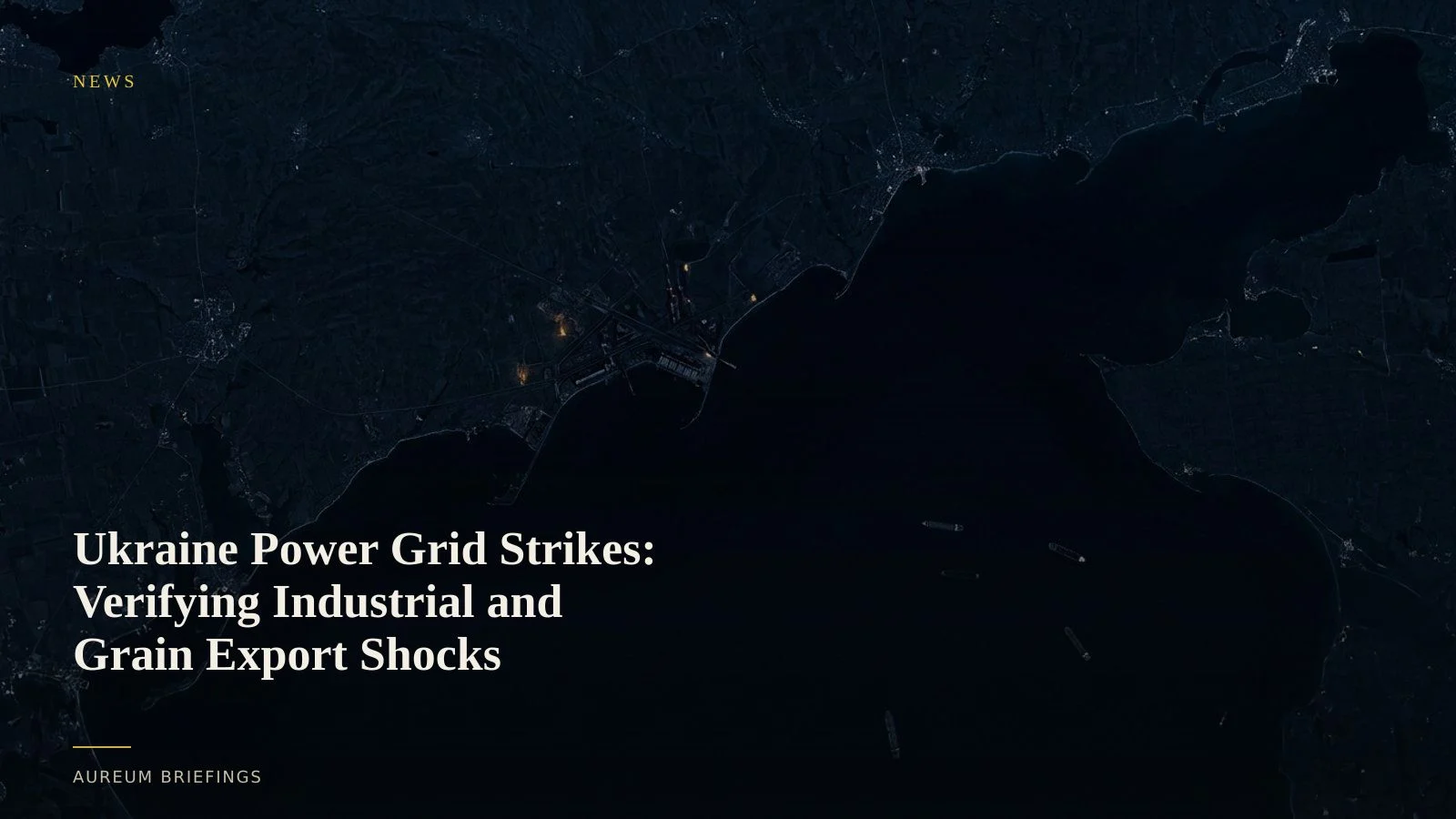
Traders apply this exact dual-sensor logic to Ukraine's export engine. Sentinel-1 radar tracks bulk carrier queues outside Chornomorsk and Pivdennyi regardless of cloud cover, while VIIRS thermal anomaly data confirms whether metallurgical blast furnaces and coking plants are maintaining heat or banking operations during power blackouts.
Separating port bottlenecks from inland harvest delays
When Ukrainian export volumes dip, traders need to know whether the bottleneck sits at the coastal terminal or inland on the farm. A backlog of empty bulk carriers anchored off Odesa alongside empty rail yards at the port points to inland electric rail disruptions or silo drying delays caused by generator fuel shortages.
Satellite evidence separates coastal logistics failures from field-level crop stress. By checking Odesa Black Sea port disruptions alongside inland grain storage and elevator operations, an analyst can see where physical tonnage is stalling.
Large commodity desks pay six-figure enterprise subscriptions for institutional geospatial platforms to automate these checks. DIY investors usually fall back to free browser tools that only provide dated imagery without analysis, leaving them guessing whether a grid strike actually halted shipments.
Turning infrastructure news into a repeatable check
Trading conflict-driven agricultural and energy shocks requires moving past wire headlines to check physical throughput. When a new report highlights severe grid degradation, the practical response is to verify whether export terminals and smelters are still moving tonnage.
With Aureum Query, you can ask about vessel staging at named Black Sea ports, check thermal activity at metallurgical complexes, or inspect winter wheat emergence across key oblasts when new passes land. Alongside Query, you can follow hand-built Track boards on major commodity corridors and smelters to keep baseline supply chains in view.
Individual commodity traders, agricultural hedgers, and independent analysts use this process to ground their positioning in physical reality before official export tallies confirm the drop.
Check the physical economy before the print
Aureum is in beta and free to join. Ask Earth a plain-English question with Query, or follow curated Track boards on global commodity sites.