Guide
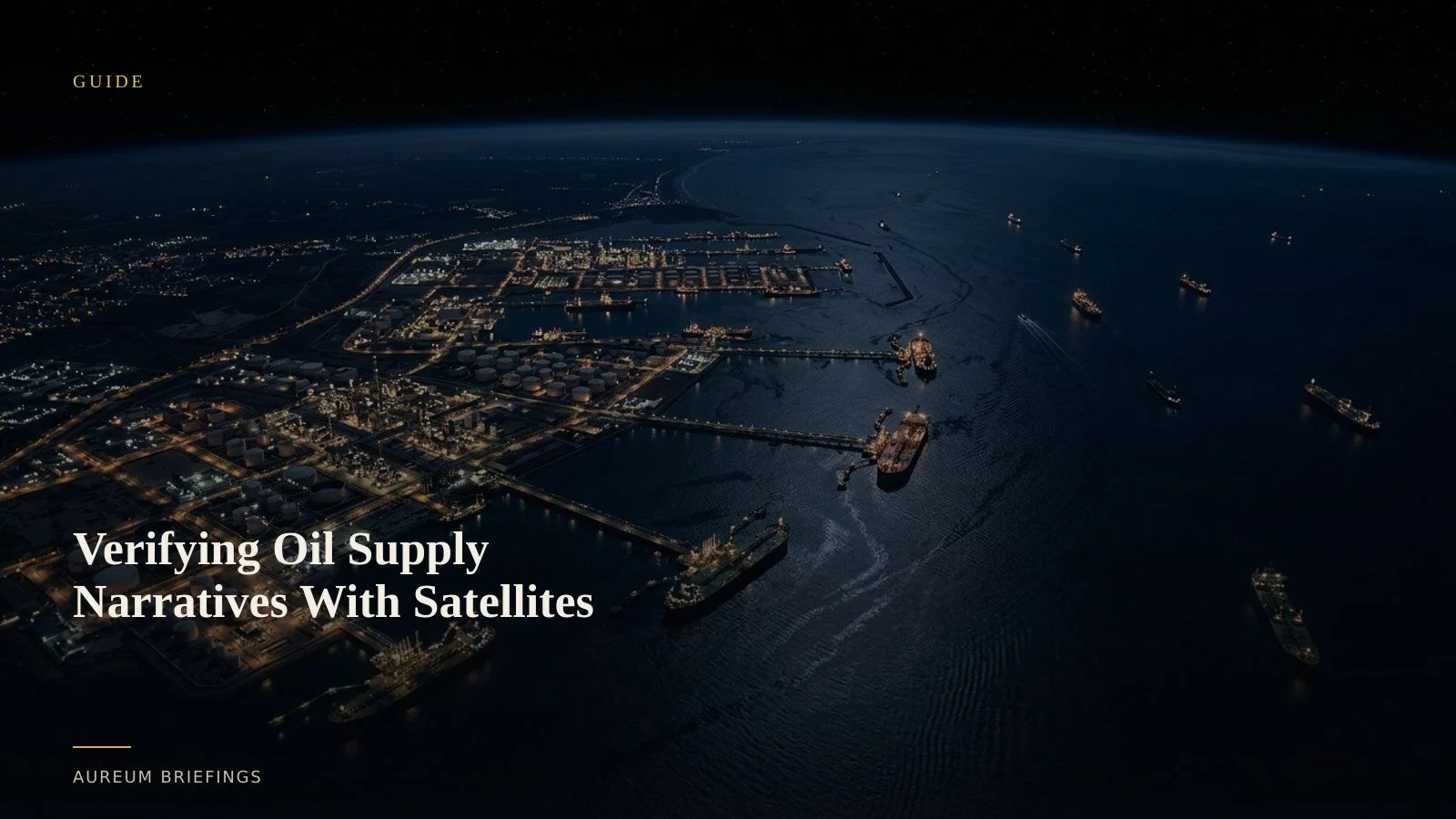
Verifying Oil Supply Narratives With Satellites
When verbal interventions and market rumours move crude futures, physical evidence shows what is actually happening in tanks and corridors.
When headlines drift from physical reality
Energy markets frequently react to press releases and strategic reserve announcements long before physical flows change. Analysts studying price dynamics highlight how information-based market narratives can temporarily sway futures pricing, even when physical market participants doubt the underlying claim.
Physical assets leave a footprint that paper declarations cannot hide. Floating-roof tanks rise and fall, tankers linger or alter course, and offshore discharges alter water scattering.
Instead of waiting weeks for delayed customs reports or government inventory prints, traders can examine physical storage sites directly through remote sensing.
Combining synthetic aperture radar with physical observables
Optical imagery can be blocked by cloud cover or darkness, but synthetic aperture radar penetrates weather constraints to track infrastructure around the clock.
Peer-reviewed research on Sentinel-1 SAR shows how multi-source remote sensing enables automated detection of marine oil spills and ocean discharges, delivering reliable mapping across varied sea states without manual feature tagging.
When applied to energy logistics, radar observation verifies ship-to-ship transfers, dark fleet activity, and sudden changes in port throughput long before official logs update.
Why an earlier signal matters before consensus forms
Traders discussing alternative datasets note that gaining even a small accuracy edge ahead of consensus can dramatically improve risk management in supply-sensitive markets.
Recent developments in planetary-scale AI remote sensing show how automated foundation models bring change detection and pattern discovery into standard analytical workflows.
Combining physical satellite signals with vessel transponder data and news streams provides a complete picture of supply tightness, helping traders spot divergence between market pricing and physical reality.
Who needs independent verification
This capability is essential for anyone trading physical or paper commodities without a multi-million-pound research desk.
DIY investors, independent commodity traders, and energy analysts use earth observation to verify whether export terminals are truly constrained, whether storage facilities are emptying, and whether shipping lanes are jammed.
Rather than reacting to market rumours, you can ground your decision process in direct physical measurements.
Verify physical signals yourself
Join the beta to ask Earth questions, or follow hand-built Track boards on named energy assets.