Ras Tanura
Ras Tanura and Abqaiq: the terminal, the refinery and the attacks
Saudi Arabia's main Gulf oil port and its processing plant, seen from orbit.
Ras Tanura is Saudi Aramco's oil port on a peninsula in the Eastern Province: a refinery of 550,000 barrels a day, piers and a Sea Island for tankers, and the Ju'aymah moorings to the north. Abqaiq, about 90 km inland, is where most Saudi oil is processed. This guide maps each place, sets out every attack with who said what, and shows what free satellite pictures caught when loadings stopped in 2026.
Satellite map
Map of Ras Tanura, Ju'aymah and Tarut Bay
Pick a number to see what is there. The picture is a single cloud-free Sentinel-2 pass from 24 November 2025, before the war. Abqaiq is about 90 km inland to the south-west, off this map, and has its own section.
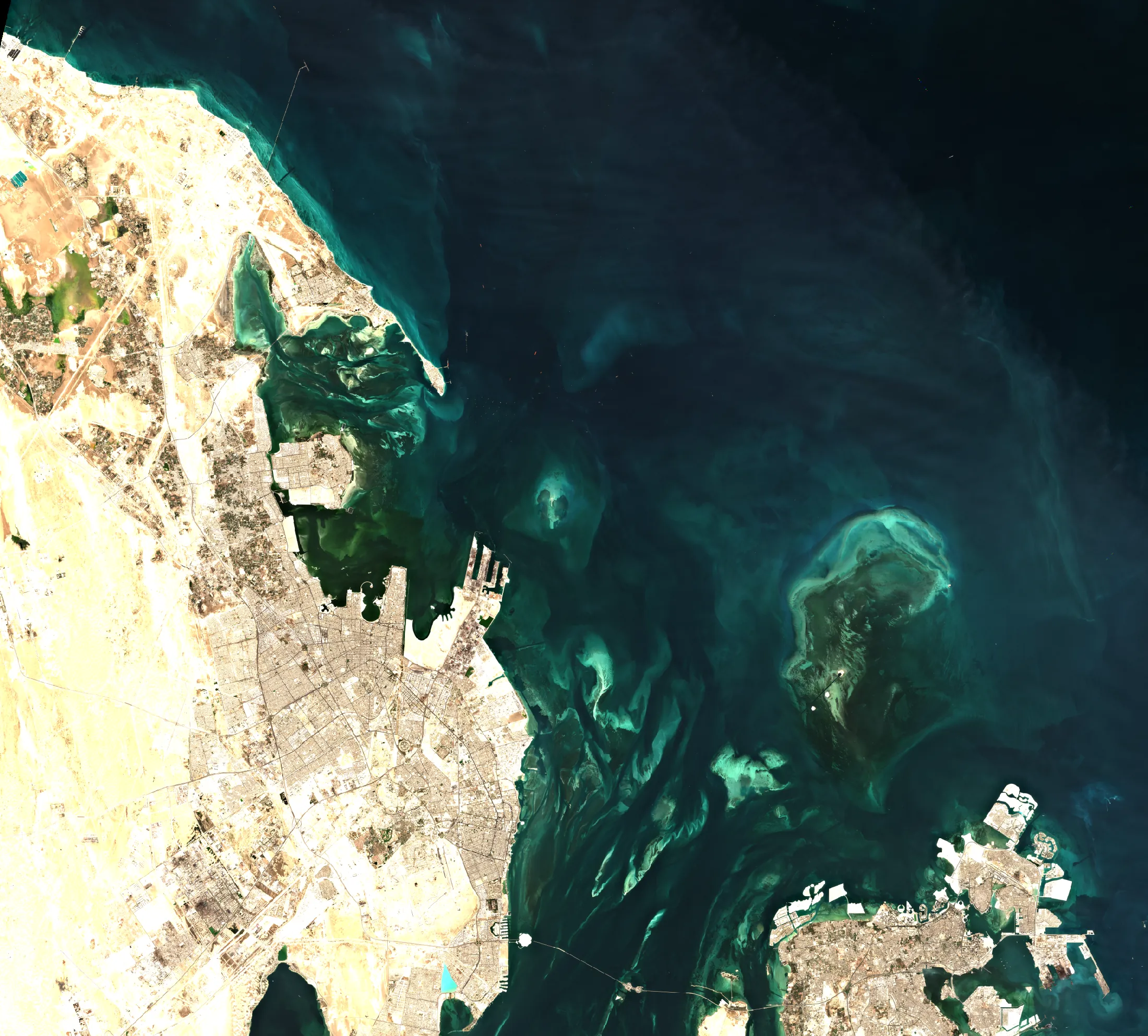
- Export terminal
The tip of the peninsula, with its tank farm and two piers. The North Pier has six berths and loads products only. The South Pier's four berths are mothballed (Aramco, 2025). The berths up close.
- Export terminal
Three offshore loading platforms joined by walkways, about a mile north-east of the North Pier. Sea Island 1 is abandoned in place. The deepest berths in the port: the maximum arrival draft is 16.3 metres, plus the tide, up to 18 metres (Aramco, 2025).
- Refinery
Saudi Aramco's refinery, with 550,000 barrels a day of crude distillation capacity (EIA, 2024), beside the Aramco community that grew around it in the 1940s. The target of drone attacks in March 2026, Saudi ministries said.
- Export terminal
The port's other two terminals, about 18 miles north-north-west of Ras Tanura: six single-point moorings for crude about 7 miles offshore, and a two-berth LPG pier at the end of a 10 km trestle, the straight line running out from the shore (Aramco, 2025).
- Town
A town on the mainland, west of the Ras Tanura peninsula.
- Island
An inhabited island in the shallow bay south of the Ras Tanura peninsula.
- Town
A city on the mainland facing Tarut Island.
- Town
The city south of Tarut Bay, about 25 km from the Ras Tanura terminal.
- Port
Dammam's sea port, on the coast south of Tarut Bay.
- Town
On 7 March 2021, shrapnel from a missile fell near Aramco's residential area here, the Saudi energy ministry said (SPA).
- Town
A city on the coast east of Dhahran.
- Town
Bahrain's capital, about 60 km south-east of the Ras Tanura terminal.
Status checkChecked
Is Ras Tanura loading oil?
Tankers are back at its crude berths. Loadings were reported halted from early March to 26 June 2026, and no large tanker was at the Sea Island on any clear satellite pass in that stretch. Two were moored there on 12 November 2026. Saudi statements confirmed attacks on the refinery in March and April; the Houthi claim of a missile hit on 27 October was not confirmed.
- Aureum satellite pass
- Two tankers at the Sea Island, 12 Nov 2026Sentinel-2C at 07:32 UTC. Both piers were empty and one more ship lay east of them. Each ship checked by eye. One frame at one moment, not a count: see the pictures.
- Crude loadings
- Resumed 26 June after nearly four months, Reuters reportedBloomberg reported on 25 June that no crude loadings had been seen at the terminal since early March. Aramco is not quoted on the halt or the restart.BBC, citing Reuters, 28 Jun 2026
- Refinery
- Houthis claimed a missile hit on 27 October; Saudi authorities did not confirm itBloomberg, citing a person familiar with the matter, reported a fire near the export terminal that was contained, with the damage unclear.Reuters, 27 Oct 2026
- Abqaiq
- Houthi claims on 29 Oct and 8 Nov; no Saudi statement that it was hitAl Jazeera found no independent corroboration of the 29 October claims. On 8 November Saudi Arabia said its air defences destroyed a missile aimed at the Eastern Province.Al Jazeera, 8 Nov 2026
- East-West pipeline
- Operations unaffected by a 9 November attack in Madinah, the ministry saidThe line from Abqaiq to Yanbu is Saudi Arabia's way round Hormuz. After attacks on 10 September it was shut, and EIA estimates it partially resumed flows from 22 September.Saudi Press Agency, 9 Nov 2026
- Oil through Hormuz
- 4.9 million barrels a day in 2Q26, against 21.6 million in 4Q25EIA's latest published quarter. Every tanker loading at Ras Tanura leaves the Gulf through the strait.EIA energy security tables
This panel is the only part of the page tied to a date. Everything below it is background that holds from week to week, with the period stated on every figure.
Fact file
Ras Tanura and Abqaiq at a glance
The background numbers, each with its period and source. The status check above covers this week.
- Operator
- Saudi Aramco
- The Port of Ras Tanura is three Aramco terminals: Ras Tanura, Ju'aymah crude and Ju'aymah LPG (Aramco, 2025).
- Where
- A peninsula in Saudi Arabia's Eastern Province
- On the Persian Gulf, north of Tarut Bay. The tip of the sand spit is officially Ras Tanura (Aramco).
- Refinery
- 550,000 barrels a day
- Crude distillation capacity in EIA's 2017 and 2024 country briefs. Reuters calls it the kingdom's biggest refinery.
- Crude berths
- Three Sea Islands, one abandoned
- Offshore platforms joined by walkways, about a mile north-east of the North Pier. Maximum arrival draft 16.3 metres plus the tide, up to 18 metres (Aramco, 2025).
- Piers
- North Pier products only; South Pier mothballed
- Six berths and four berths (Aramco, 2025).
- Ju'aymah
- Six crude moorings and an LPG pier
- About 18 miles north-north-west of the terminal. The moorings are 7 miles offshore, and the LPG pier ends a 10 km trestle (Aramco, 2025).
- Port capacity, EIA 2017
- About 6.5 million barrels a day
- EIA's figure for the whole port, which it called the world's largest offshore oil exporting port. Its 2024 brief does not repeat it; Aramco gives hourly rates.
- First cargo
- 1 May 1939
- King Abdulaziz opened the valve that loaded the tanker D.G. Scofield, moored about a kilometre offshore (Aramco).
- Abqaiq
- About 7 million barrels a day
- EIA's 2019 capacity for the world's largest crude processing and stabilisation plant, about 7% of global crude production capacity.
- East-West pipeline
- 5 million barrels a day
- From Abqaiq to Yanbu on the Red Sea (EIA, 2025). Aramco says it reached its 7 million maximum in the first quarter of 2026.
- Saudi crude through Hormuz, 2024
- 5.5 million barrels a day
- 38% of the crude through the strait (EIA).
- Loadings halted, 2026
- Early March to 26 June
- As Bloomberg and Reuters reported. No large tanker was at the Sea Island on any clear Sentinel-2 pass between 7 March and 22 June.
Where is Ras Tanura?
Ras Tanura is on a sand-spit peninsula on the Saudi coast of the Persian Gulf, in the Eastern Province, about 25 km north of Dammam and about 60 km north-west of Bahrain's capital, Manama. The tip of the spit, officially Ras Tanura, carries the oil terminal: a tank farm, two piers and, about a mile beyond the northern one, the Sea Islands. The refinery and the town sit further up the peninsula. Britannica describes it as a principal Persian Gulf terminal of the pipelines, with a port that can take the largest tankers (Britannica).
The refinery, the terminal and Ju'aymah
| What it is | Status and source | |
|---|---|---|
| Refinery | Crude oil refinery on the peninsula | 550,000 barrels a day of crude distillation capacity (EIA, 2024) |
| South Pier | T-head pier with four berths, numbered 1 to 4 | Mothballed (Aramco, 2025) |
| North Pier | Six berths, numbered 6 to 11, about three-quarters of a mile north of the South Pier | Products only (Aramco, 2025) |
| Sea Islands | Three offshore platforms joined by walkways, about a mile north-east of the North Pier | Sea Island 1 abandoned in place (Aramco, 2025) |
| Ju'aymah crude | Six single-point moorings 7 miles offshore, about 18 miles north-north-west of Ras Tanura | Crude and bunker fuel loading for deep-draft tankers (Aramco, 2025) |
| Ju'aymah LPG | Two-berth pier at the end of a 10 km trestle | Refrigerated LPG for carriers of 25,000 to 200,000 tonnes deadweight (Aramco, 2025) |
Aramco's port book, Ports and Terminals, 2025 edition, lists the crude grades loaded at Ras Tanura as Arabian Extra Light, Arabian Light, Arabian Medium and Arabian Heavy, plus gas condensate.
How big is Ras Tanura?
The numbers in circulation measure different things, at different dates, and some have no source. This is what each source actually says.
| Figure | Who says so, and when | |
|---|---|---|
| Refinery crude capacity | 550,000 barrels a day | EIA country briefs, 2017 and 2024; Reuters, 2026 |
| Whole-port handling capacity | About 6.5 million barrels a day | EIA, October 2017, citing Aramco; not repeated in 2024 |
| Ras Tanura terminal | About 3.4 million barrels a day, and 33 million barrels of storage | EIA estimate and Energy Intelligence, 2017 |
| Ju'aymah crude terminal | About 3.12 million barrels a day | EIA, 2017, derived from Aramco's port book |
| Largest tankers | 500,000 tonnes deadweight at Ras Tanura; 700,000 at Ju'aymah | EIA, 2017, citing Energy Intelligence |
| Ju'aymah loading rate | Up to 130,000 barrels an hour | Aramco, 2025 |
| Sea Island draft | 16.3 metres, up to 18 with the tide | Aramco, 2025 |
A line that turns up on reference pages, and in the AI answers that quote them, says Ras Tanura handles about a fifth of the world's oil exports. We found no EIA or Aramco figure that says so. EIA's own measure is a handling capacity: about 6.5 million barrels a day for the whole port, in a 2017 brief (EIA).
The refinery's age depends on which line of Aramco's history you read. A 3,000-barrel-a-day 'tea kettle' refinery opened in 1941 and closed six months later because of wartime shortages. Aramco dates the main refinery to 1945, while noting that the war ended before it began operating, and gives 1947 as its first full year, at 50,000 barrels a day (Aramco history). The first crude cargo was loaded at Ras Tanura on 1 May 1939, when King Abdulaziz opened the valve to the tanker D.G. Scofield (Aramco).
Abqaiq: where Saudi crude is processed
Abqaiq is inland, about 90 km south-west of Ras Tanura. It is not a port or a refinery. EIA describes it as Saudi Aramco's largest oil processing facility and crude stabilisation plant, where most Saudi oil is processed before it is exported or refined, with pipelines to Jubail and Ras Tanura (EIA, 2017). In 2019 EIA put its capacity at 7 million barrels a day, about 7% of the world's crude production capacity (EIA).
Abqaiq is also where Saudi Arabia's way round the Strait of Hormuz begins. The East-West pipeline carries 5 million barrels a day from Abqaiq to Yanbu on the Red Sea, and was expanded to 7 million temporarily in 2019 (EIA).
The attack of 14 September 2019
Drones and missiles hit Abqaiq and the Khurais oil field. Aramco said the fires suspended 5.7 million barrels a day of crude output (Aramco). The Houthis claimed the attack; Saudi Arabia and the United States blamed Iran, which denied it (BBC). A UN panel of experts later found the Houthis unlikely to be responsible, because the weapons' range did not allow a launch from territory they held (UN, S/2020/70).
Three days later Aramco said Abqaiq was back at 2 million barrels a day, with the lost output to be restored by the end of September (Aramco).
Attacks on Ras Tanura and Abqaiq, and who said so
Claims, Saudi statements and news reports often disagree on what was hit, by what and by whom. Each row keeps the speaker.
14 Sep 2019
7 Mar 2021
Tank farm targeted from the sea
The energy ministry said a drone from the sea attacked a tank farm at Ras Tanura port, and that missile shrapnel fell near Aramco's residential area in Dhahran, with no injuries (SPA). The defence ministry said the drone was destroyed before it reached its target (SPA). Neither named an attacker.
Terminal2 Mar 2026
Limited fire at the refinery
The energy ministry said debris from two intercepted drones caused limited damage and a limited fire, immediately contained, and that some units were shut as a precaution (SPA). An industry source told Reuters the refinery was shut as a precaution.
Refinery4 Mar 2026
Second attempt, no damage
Saudi defence and energy officials said an attempted drone attack on the refinery caused no damage and no disruption to supplies (SPA). Reuters reported that three sources said Ras Tanura had been struck, without details of damage.
RefineryEarly Mar 2026
Crude loadings stop
No crude loadings were seen at the terminal from early March, Bloomberg reported on 25 June (Bloomberg). Aramco is not quoted on the halt.
Terminal13 Mar 2026
Refinery restarts, a monitor says
Industry monitor IIR told Reuters that Aramco restarted the refinery on 13 March (Reuters). No Aramco or ministry statement gives that date.
Refinery9 Apr 2026
Ministry lists facilities hit
The energy ministry said recent attacks had hit the Ras Tanura refinery among other sites, directly affecting exports of refined products, and had cut about 700,000 barrels a day from the East-West pipeline at one pumping station (SPA). It said full pipeline capacity was restored by 12 April.
Refinery26 Jun 2026
Loadings resume
Aramco resumed crude loadings at the terminal on Friday 26 June after nearly four months, Reuters reported (BBC).
Terminal28 Jun 2026
Helicopter crash
An Aramco helicopter crashed in Ras Tanura, killing all 14 people on board. The energy ministry opened an investigation and gave no cause (SPA).
Accident27 Jul 2026
Houthi claim on the route to Yanbu
The Houthis said they targeted crude supply sites linking eastern Saudi Arabia to Yanbu. Reuters published a Copernicus Sentinel-2 image of smoke at an oil facility in Abqaiq that day; Aramco did not immediately comment (Reuters).
Abqaiq10 Sep 2026
27 Oct 2026
Fire near the export terminal
The Houthis said a ballistic missile hit the refinery; Saudi authorities did not immediately confirm it. Bloomberg, citing a person familiar with the matter, reported a fire near the terminal that was contained, with the damage unclear (Reuters).
Refinery29 Oct and 8 Nov 2026
More claims, no confirmation
Houthi statements listed the Ras Tanura refinery and an Aramco facility in Abqaiq among their targets. Al Jazeera found no independent corroboration, and no Saudi statement said Abqaiq was hit (Al Jazeera).
Claims
Saudi statements on the 2021 and March 2026 attacks named no attacker. Some summaries call the March 2026 attacks Iranian-linked; the ministry statements quoted here do not. The Houthis claimed attacks on Saudi oil sites from July 2026 onwards.
Ras Tanura and the Strait of Hormuz
A tanker loading at Ras Tanura has one way to open water: down the Gulf and through the Strait of Hormuz. In 2024 Saudi Arabia shipped 5.5 million barrels a day of crude and condensate through the strait, 38% of the crude that crossed it (EIA).
When the war began on 28 February 2026, the way round mattered. Aramco said it ran the East-West pipeline at its 7 million-barrel maximum in the first quarter, to export more from the west coast (Aramco). EIA estimates the line was carrying more than 5 million barrels a day of exports through Yanbu before attacks on it in September (EIA).
Yanbu's cargoes still have to leave the Red Sea, through Bab el-Mandeb or Suez, and on 20 July 2026 the Houthis declared a blockade of Saudi shipping. The bypass moved part of the risk to another chokepoint.
Ras Tanura from space: what the satellites showed in 2026
Sentinel-2, the European Union's free Copernicus imaging satellites, photographs Ras Tanura every few days at 10 metres per pixel, and the sky over the Gulf coast is often clear. That is enough to show a tanker alongside a berth as a long pale hull, and not enough to show a name, a cargo or how full the tanks are (ESA).
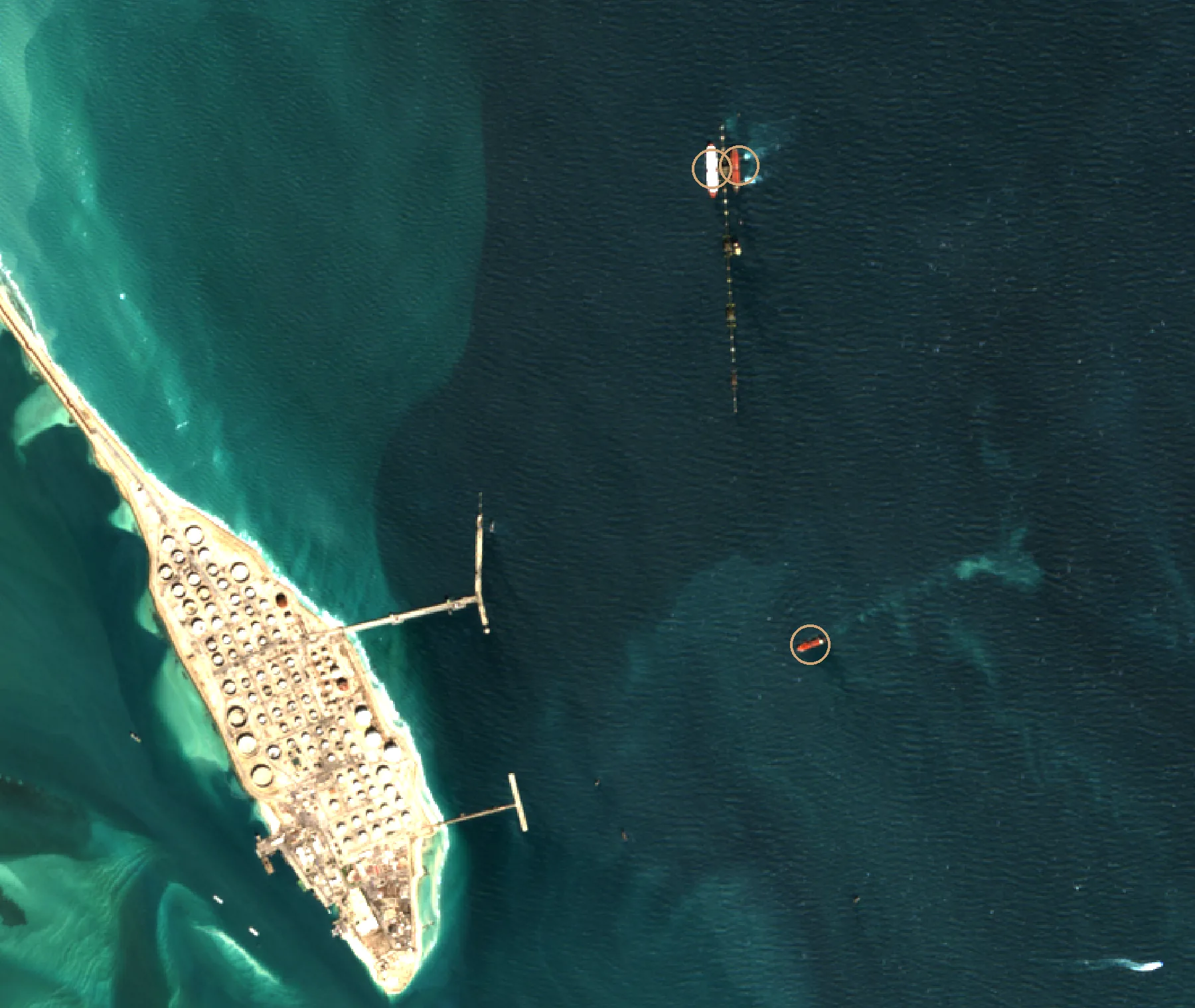
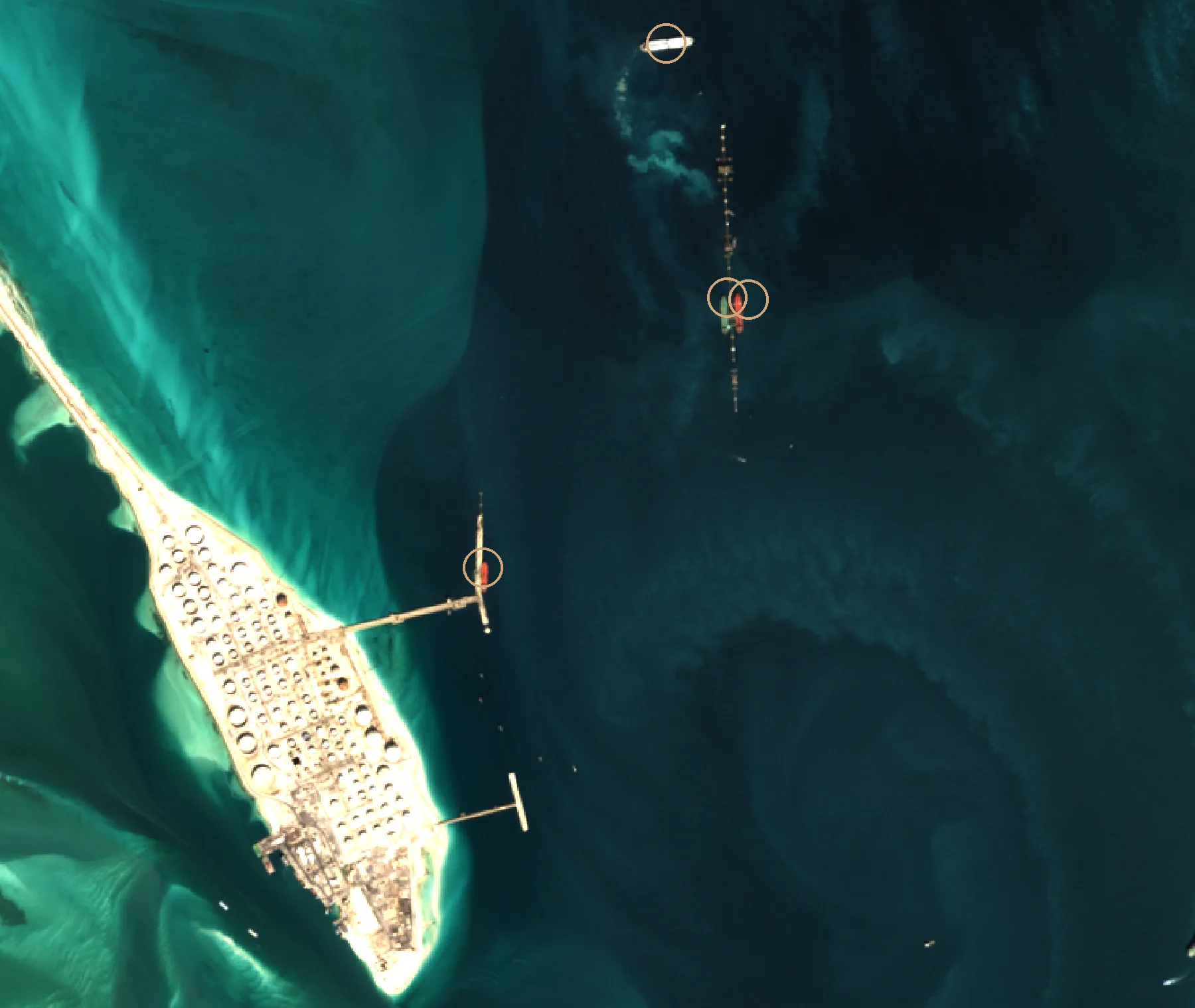
A year apart, the berths look much alike. The year in between did not. Bloomberg reported that no crude loadings were seen at the terminal from early March 2026, and Reuters that they resumed on 26 June. The Sea Island, where the large tankers berth, tells the same story.
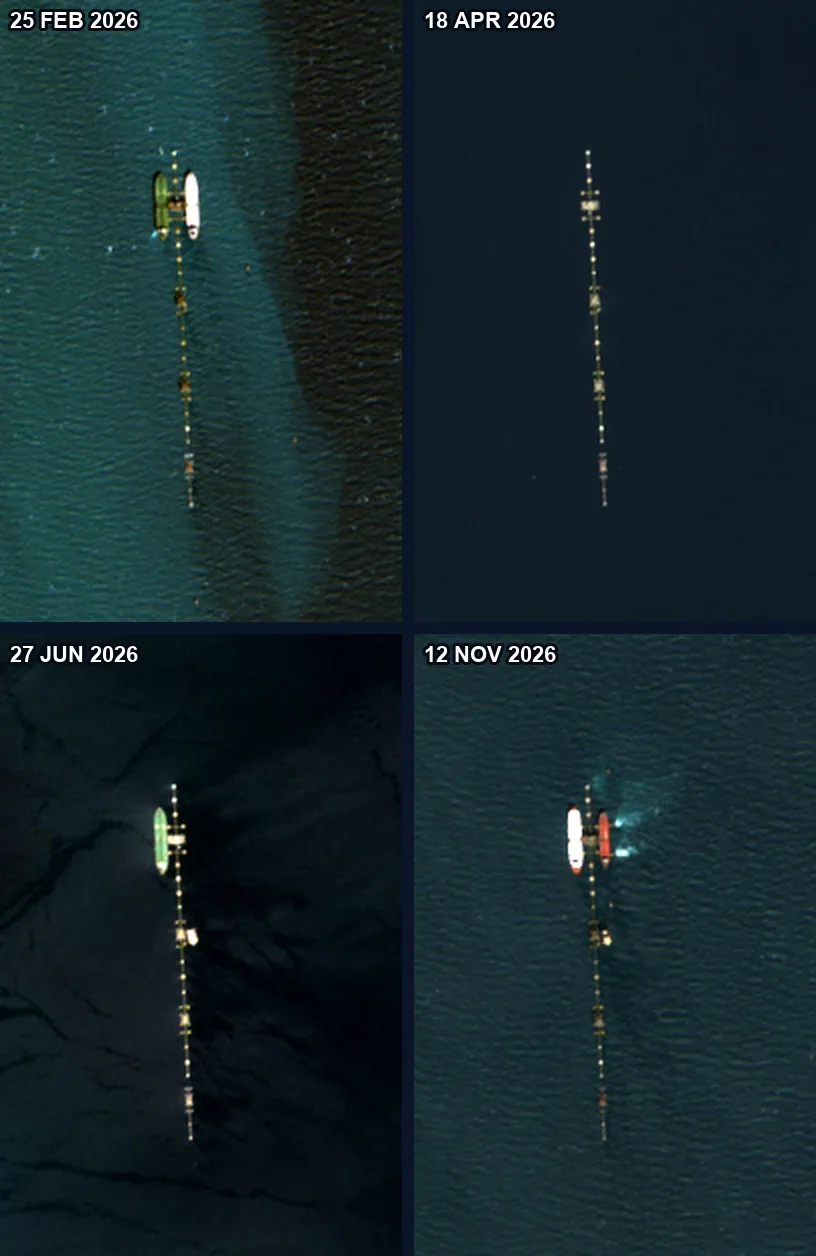
On all 14 clear passes from 7 March to 22 June 2026, no large tanker was moored at the Sea Island. A smaller vessel, about 100 metres long, lay beside its middle platform in mid-June. The North Pier, which loads products only, still had a ship alongside on several of those passes. The pictures agree with the reports. They do not prove them, and they say nothing about how much oil was loaded.
What these pictures can and cannot show
- Can show: a large hull alongside a pier or the Sea Island at the moment of the pass, and the layout of the piers, the Sea Island and the tank farm.
- Cannot show: barrels, how full a tank is, which grade is loading, whether a refinery unit is running, or who fired at it.
- Cannot see through cloud: Sentinel-2 is an optical camera. Ras Tanura is often clear, but not always.
- Not a count of the port: one picture is one moment. A berth empty at 07:30 UTC may be busy by noon.
Pictures of Ras Tanura reach the public Sentinel-2 catalogue about five hours after each pass, the median of the passes we checked from June to November 2026. An EU Council decision of July 2026 to delay Sentinel data by 24 hours covered an area of the Gulf of Oman east of 59.6 degrees east, far from Ras Tanura and Abqaiq, and the Official Journal declared its publication null and void on 29 July (corrigendum). How Aureum reads a pass is on How we measure, and the satellite image date checker shows when a free satellite last passed over a place.
How to follow Ras Tanura yourself
No single source tells you what Ras Tanura is doing. Each one measures something different, on its own clock. Read them together.
| What it shows | How often | Watch out for | |
|---|---|---|---|
| Saudi Press Agency | Energy and defence ministry statements on attacks and precautions | When issued | Names facilities, rarely volumes or durations |
| Aramco | Results, the port book, statements | Quarterly, or when issued | Gives hourly loading rates, not daily exports |
| EIA | Oil flows, pipeline estimates, country briefs | Monthly outlook | 2026 figures are estimates, revised often |
| News agencies | Loadings, outages and claims, often from unnamed sources | Daily | Accounts disagree; check who is speaking |
| Houthi statements | Claims of attacks | When issued | Often not independently corroborated |
| Sentinel-2 pictures | Hulls at the berths, broadcasting or not | Every few days, in clear weather | 10 m detail; one moment, not a total |
| AIS ship trackers | Positions that ships broadcast | Minutes to hours | Ships can switch AIS off or fake a position |
Primary sources worth bookmarking: the Saudi Press Agency, EIA's Short-Term Energy Outlook, Aramco's ports book, and the Copernicus Browser for Sentinel-2 pictures. The satellite image date checker shows when a free satellite last passed over a place.
Or let Aureum do the reading
Ask Query about Ras Tanura
Ask whether tankers were at the Sea Island on a given day, or what changed at the refinery, and get a written answer with the satellite pictures attached.
Follow the Strait of Hormuz on Track
A hand-built board on the strait every Ras Tanura tanker crosses: a daily count of the ships that broadcast as they cross, settled the next day.
Ras Tanura and Abqaiq: questions and answers
Ask Aureum about Ras Tanura
A plain-language question about the terminal, the refinery or Abqaiq, and a written answer with the satellite pictures attached. Free while Aureum is in beta.